Liverpool, Merseyside, United Kingdom
Laing O’Rourke Builds Iconic Stadium Supporting Everton Football Club and Regeneration of North Liverpool
SYNCHRO™ Facilitates Collaborative, Strategic Construction Methods to Deliver the Megaproject
Laing O’Rourke
Renovating A World-Famous Waterfront
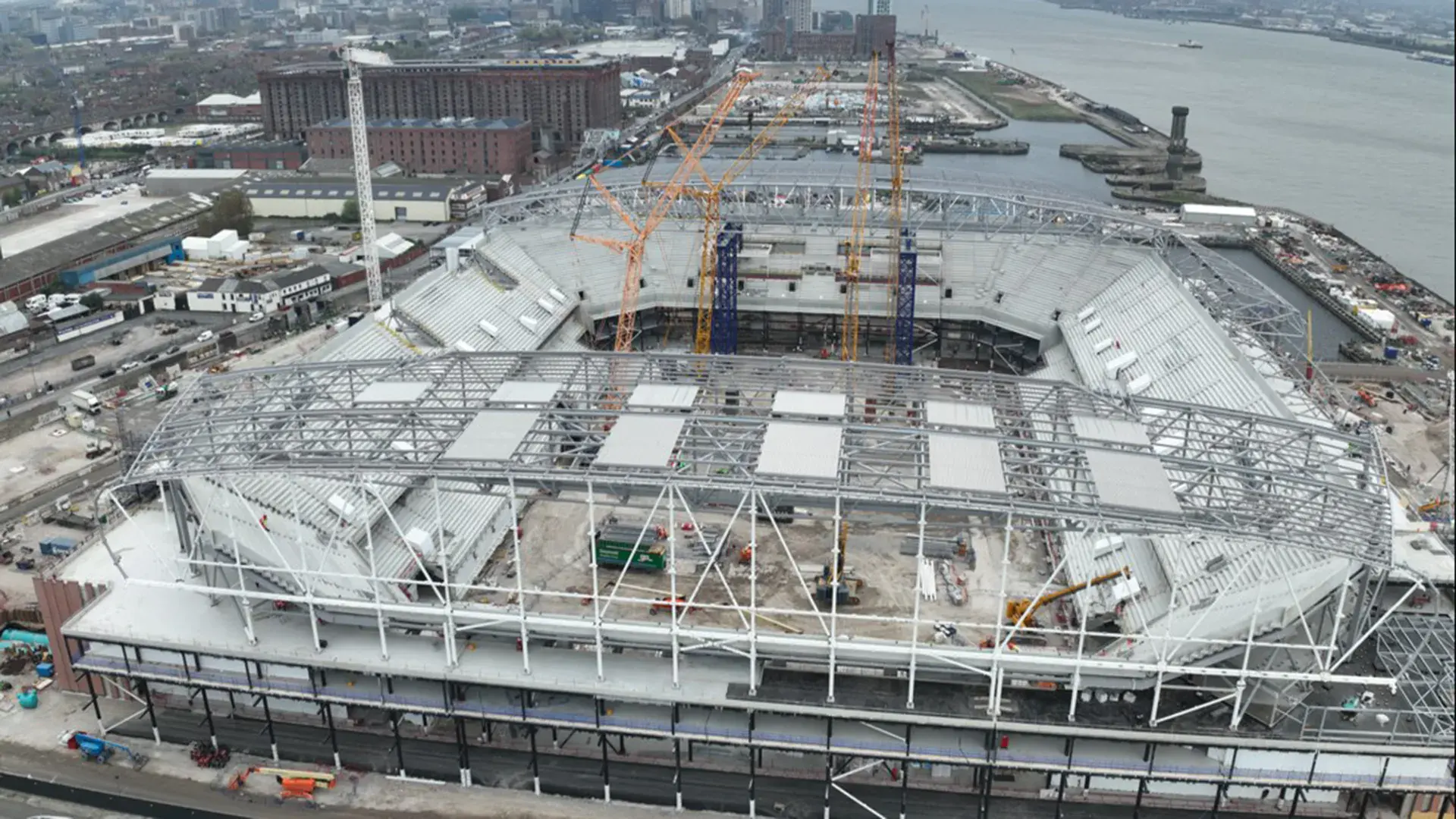
Seeking to elevate their supporters’ match day experience, the English football club Everton FC is developing a new state-of-the art stadium at the abandoned Bramley-Moore Dock on the banks of Liverpool’s Mersey waterfront. The new facility is part of a city masterplan to renovate 60 hectares of historic docklands, creating a world-class, mixed-use waterfront quarter that will help rejuvenate Liverpool and boost its economy. To respect the former UNESCO heritage site, Everton is investing GBP 55 million of the project’s total budget to preserve, restore, and celebrate the Bramley-Moore Dock’s legacy and its cultural assets. Their vision is to bring the dock back into productive use as a sports venue and community space.
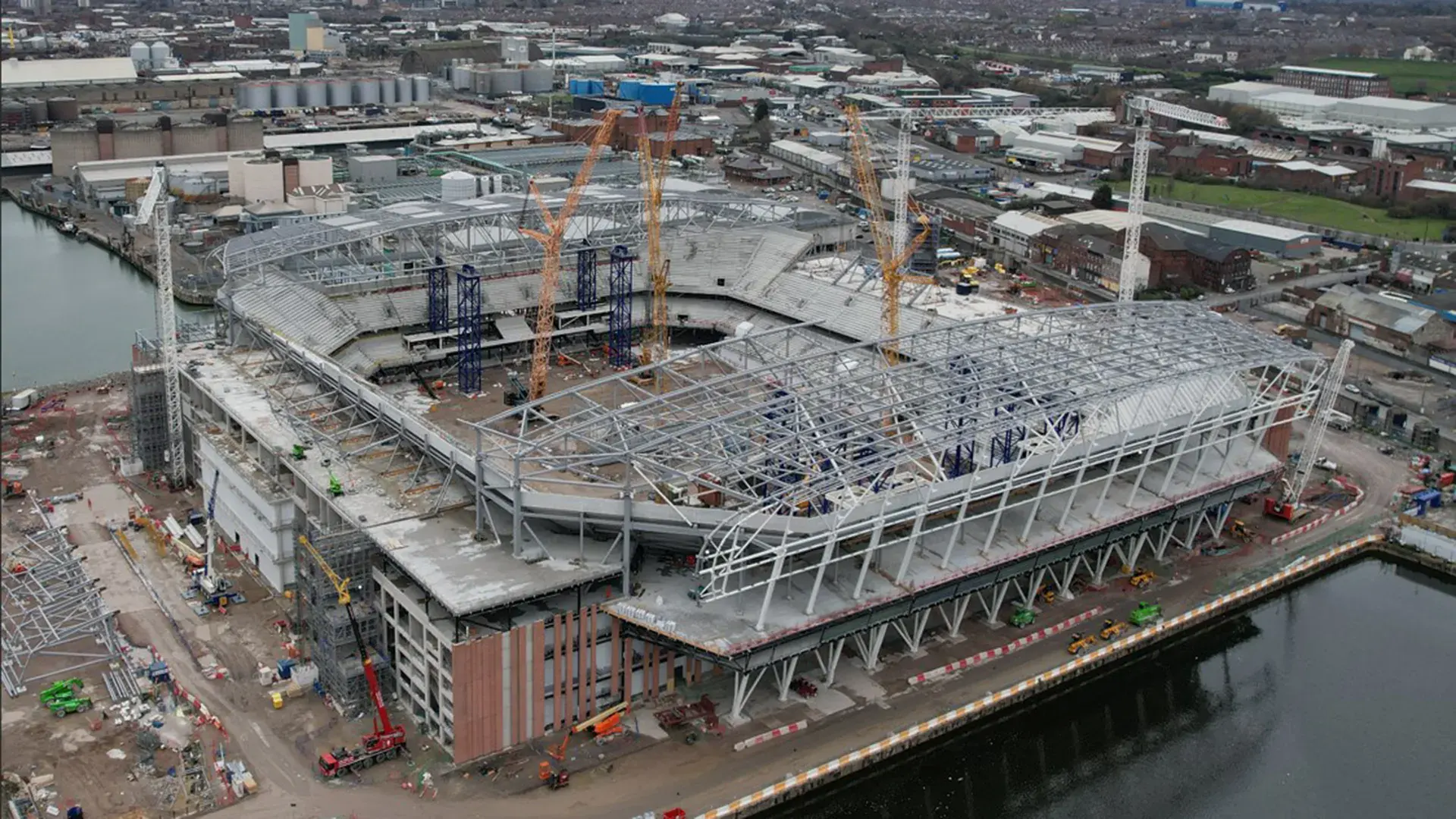
Laing O’Rourke is the main contractor for the 52,888-seat stadium, which will provide an iconic home for the football club and help revive the dockland area. Recognized as the largest single-site private sector development in the country, the GBP 555 million project is forecast to contribute GBP 1.3 billion to the local economy, creating tens of thousands of jobs and attracting 1.4 million tourists to Liverpool annually. Due to be complete in 2024, Laing O’Rourke initiated precise planning from the outset to deliver the large-scale project on time and within budget. “The project went through a rigorous planning procedure, though was met with overwhelming support from the community as it was to aid an overall Liverpool City Dock Development plan and provide the community with jobs and career prospects,” said Simon Beards, principal planner at Laing O’Rourke.
Logistical Confinements And Heritage Requirements Demand Precise Planning
Located on a heritage waterfront site, the project required strict conservation and sustainability protocols to minimize environmental impact, and presented weather-related and logistical challenges, necessitating precise planning. Prior to construction of the superstructure even starting, an enormous infill of the 10-meter-deep, grade II historic Bramley-Moore Dock had to be carried out, requiring 450,000 cubic meters of fluidized sand. The sandy infill material sits on the dock’s soft silts at the bottom of the dock, transforming the maritime port into a solid platform of reclaimed land that will support the stadium and take decades to fully settle. “A decision was made early in the project to retain the dock’s silts, which isn’t particularly normal for this type of project,” explained Gerald Knights, engineering lead at Laing O’Rourke. “But we did it because it is really great for the environment, although it does give rise to engineering challenges.”
Once the initial foundation works were complete, Laing O’Rourke needed to ensure that its construction methodologies for the stadium superstructure adequately addressed the site constraints and limited accessibility, all while adhering to the preservation requirements. From a safety and sustainability perspective, they realized that they needed off-site prefabrication to better implement a design for manufacture and assembly process. However, this process required massive coordination of 11,000 precast concrete components and a supporting steel skeleton frame. Laing O’Rourke had to logistically manage not only the transport of the manufactured modules to the site, but also the heavy equipment and cranes necessary to install the components on site. “This put a heavy reliance on coordination of the work with crane management and clash avoidance due to the heavy costs a delay would incur,” said Beards. To successfully deliver the project, Laing O’Rourke sought a combination of advanced digital design and 4D construction solutions to plan everything in a virtual environment prior to any on-site works.
Key Takeaways
- The new stadium at Bramley-Moore Dock in Liverpool will provide Everton Football Club with a modern, iconic home for future fans and football generations.
- Laing O’Rourke needed to ensure precise planning and sustainability throughout construction to meet schedule, budget, and preservation requirements.
- They used SYNCHRO to perform 4D construction simulations, streamlining workflows and managing logistics amid the constrained site.
- SYNCHRO not only facilitated precise planning of on-site construction works, but it also ensured that the works contributed to the sustainability of the project, limiting environmental impact and helping reach Laing O’Rourke’s target of reusing 95% of all on-site materials.
Project Playbook

Leveraging Synchro For Collaborative, Sustainable Construction
“Before a spade went into the ground, the entire stadium was broken down in the digital realm,” said Ellis McNulty, digital build lead at Laing O’Rourke. The team built a master federated 3D model, including structural and architectural models, steel work assemblies, and prefabricated concrete walls. They then used SYNCHRO to link the 3D models to the construction schedule. Having already used SYNCHRO to win the project bid, Laing O’Rourke trusted the Bentley solution to help meet project goals, increase communication across the entire project team, and plan and execute the construction works. “[SYNCHRO] became more than just a bidding application and became our means of communication to the whole project team and beyond,” said Beards. The SYNCHRO 4D model has been fundamental to the team’s collaboration, providing a virtual environment to visualize the construction sequence and assess potential risks and clashes prior to work on site.
Using the 4D model, Laing O’Rourke has been able to precisely plan and coordinate the logistics with suppliers and manufacturers to ensure that the materials and pre-fabricated components arrived on site at the right time. “There are thousands of components on the job, all of which are being produced at our manufacturing facility in the East Midlands: beams, columns, lattice planks. In total, roughly 6,000 components will eventually come out of the factory. We modeled each of those components in the digital environment first to ensure that they will work and to know what order they need to arrive on site,” said Knights. By working in a digital environment, Laing O’Rourke was able to efÏciently manage cranes and other installation equipment and machinery required for the on-site assembly. This efficiency not only streamlined the works and avoided potential issues, but also ensured a sustainable construction methodology.
4D Construction Transforms Project Delivery
Working in SYNCHRO’s digital construction environment, Laing O’Rourke optimized planning and scheduling, keeping contractors and stakeholders updated on progress, as well as allowing them to be valuable contributors without them needing to be on the project site. On site, the 4D model is also accessible to the field teams via mobile applications, enabling them to complete their daily activities and provide status updates in accordance with the planned schedule. “The real value has been the opportunity to share the overall plan with the whole team rather than working independently or in a siloed approach,” said Beards. Using Bentley’s 4D construction solution enabled multiple disciplines and the entire project team to work and collaborate together in a digital environment.
SYNCHRO not only facilitated precise planning of on-site construction works, but it also ensured that the works contributed to the sustainability of the project, limiting environmental impact and helping reach Laing O’Rourke’s target of reusing 95% of all on-site materials. The 4D construction platform helped the team manage the logistics of transporting the prefabricated factory components to the dockland area, as well as the seamless coordination of the assembly and installation. This workflow helped solidify the work sequence and avoid on-site equipment clashes. Successfully working in a collaborative 4D digital environment optimized project delivery, saving time and cost, while improving safety and sustainability. Using SYNCHRO has transformed how Laing O’Rourke will deliver their construction projects, with the team implementing these more efÏcient processes across all future projects. “This project has really allowed us to get more out of SYNCHRO than ever before, and we’re very keen to keep pushing the boundaries in what the software will enable us to do,” said Beards.