

Edmonton, Alberta, Canada
City of Edmonton develops advanced model to track movement amid rapid growth
Bentley OpenPaths™ provides calibrated travel model and credible insights for long-term transportation planning
City of Edmonton
Modeling Demands On A Growing City’s Infrastructure
Edmonton, the capital city of Canada’s Alberta province, saw a record population increase of nearly 5% last year, cementing projections for profound growth over the coming decades. Currently a city of around 1.2 million, Edmonton is expected to be home to 2 million residents by 2065.
As part of its long-term planning to accommodate this influx, the city’s urban systems assessment unit set out to upgrade Edmonton’s Personal Travel Model (PTM), one major component of their Region Travel Model (RTM) to better track residents’ movement patterns and transit use. City planners needed to understand how people were moving through Edmonton, including when, where and why they used transportation infrastructure. They hoped to translate insights about city-wide travel demand into wiser long-term planning for the growing city, while also becoming more responsive to immediate system demands.
Re-Platforming For Better Efficiency And Calibration
Edmonton’s existing PTM is executed under a customized Python scripting environment. The stochasticity of that model made it difficult to separate systematic effects from random effects, and city engineers knew that updating it would be a complex challenge. Instead, project engineers wanted to migrate the model to a new platform that would allow more frequent validation and calibration of movement data. They aimed to use readily available resources, such as traffic counts and survey data, to refine the model.
The transparent, user-friendly interface offered by Bentley’s OpenPaths application made it the ideal platform for the city’s upgraded PTM. Bentley OpenPaths also allowed for faster convergence and more stable simulations, making it easier to represent current transportation patterns and perform scenario testing.
Key Takeaways
- Anticipating its population to grow by about 800,000 people by 2065, the city of Edmonton decided to update its advanced PTM, one major component of its Region Travel Model (RTM), to leverage insights
about population movement and transit demands for efficient long-term planning. - The city of Edmonton chose to migrate its existing, Python-based PTM to Bentley OpenPaths AGENT due to its user-friendly interface and its ability to produce more frequent, better-calibrated data.
- The new model provides enhanced data on greenhouse gases associated with transportation use patterns, allowing for better assessment of environment impacts in Edmonton.
Project Playbook

Maximizing Bentley OpenPaths Functionalities For Detailed Analysis
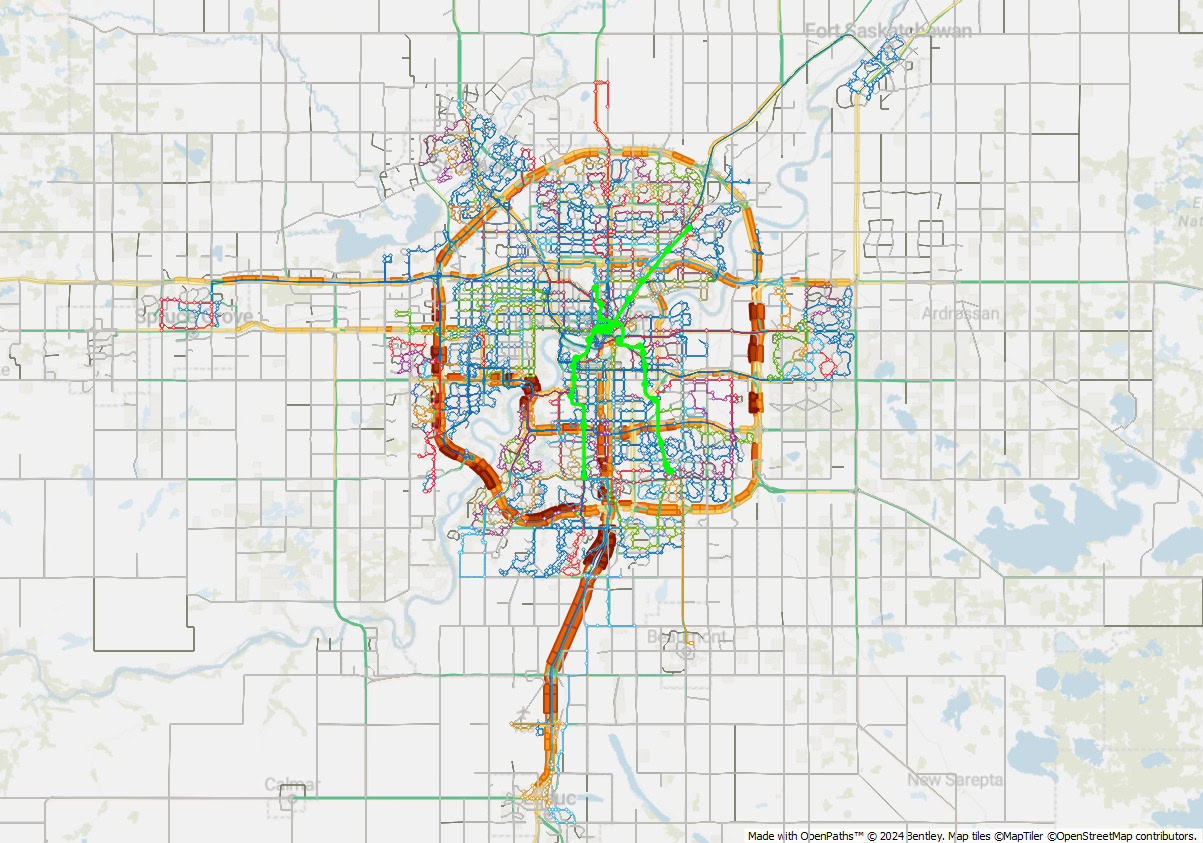
Already equipped with more than 30 years of experience using Bentley applications, the city re-platformed the PTM model into Bentley OpenPaths AGENT® , which provided advanced transportation demand modeling, including the ability to forecast mobility decisions down to the individual level. Additionally, Bentley OpenPaths DYNAMEQ® was employed to provide traffic operational analysis, and Bentley OpenPaths CityPhi® provided detailed visual analysis of trip patterns and activities within the city.
Project engineers said these solutions allowed them to manage time more efficiently and provide timely updates to the model. The functional and accessible Bentley OpenPaths interface also allowed them to answer questions comfortably with more evidence-based information, translating to better service for clients and the community.
An Efficient Model For A Fast-Changing Planning Environment
After migrating the PTM to Bentley OpenPaths AGENT, the PTM’s runtime for person trip projections improved by 50%, resulting in an overall saving of about 11% in the entire RTM runtime. Additionally, convergence time also significantly decreased due to stochastic options included in Bentley OpenPaths AGENT, allowing for faster and more efficient updates.
“Re-platforming our personal travel model into the Bentley OpenPaths EMME® and Bentley OpenPaths AGENT platforms has been a game-changer,” said Rajib Sikder, a project engineer with the city of Edmonton. “We can now use readily available data to update the model behavior more frequently, reflecting the fast-changing transportation and city planning environment. This capability is crucial for making timely and accurate decisions.”
With the ability to better quantify traffic, transit ridership, and other relevant data, project engineers anticipate the new model will better represent environmental impacts in addition to current transportation patterns. The city intends to use its enhanced ability to calculate greenhouse gas emissions to perform an equity-focused analysis of how various communities are affected by environmental transportation impacts.