

London, England, United Kingdom
Transport for London Delivers the Elizabeth Line, London’s Largest Addition to Public Transport in over 50 Years
Bentley OpenPaths™ EMME® helped improve commuter experience, bringing an additional 1.5 million people within 45 minutes of Central London
Transport for London
Public Transport To Support The Economic Growth Of London
The Elizabeth Line is the largest single addition to London’s public transport network since the Victoria Line in 1968. Intended to support economic growth by tackling congestion on the existing rail network and improving rail access into and within London, the Elizabeth Line connects Greater London with the main financial and leisure districts, including the U.K.’s largest airport Heathrow. The service is named after Queen Elizabeth II, who officially opened the line in May 2022 in honor of her platinum jubilee. Fully opened in May 2023, the line operates up to 24 trains per hour with capacity for 1,500 passengers per train and served 210 million passengers in 2023-2024, transforming how passengers use public transport within London.
Transport for London (TfL) is the local government organization responsible for most aspects of London’s transport system, running the day-to-day operation of the capital’s public transport network and managing London’s main roads. “Created in 2000, TfL run and manage bus services, the Underground, Docklands Light Railway, overground, tram, road and river networks, and a cable car,” explained David Warner, principal transport modeler at TfL. “Now, the Elizabeth line has been added, including another 10% of capacity to the rail network.”
Planning Public Transport In London For Over 20 Years
The Elizabeth line stretches more than 100 kilometers in the west through central tunnels in the east. “Construction of the GBP 19 billion project started in 2011, and we had a phased opening between May 2022 and May 2023,” said Hannah Donovan, transport modeler at TfL. But the planning work started much earlier, before even the 2008 Crossrail Act was submitted to U.K. Parliament as a mechanism to fund and deliver the route. Given the scale and complexity of the project, a suitable tool was required to inform planning decisions.
TfL sought transportation planning, modeling, and analysis software to assist with conceptual creation, route selection, and final delivery of the operational railway. “Journey times and connectivity are key drivers of public transport demand in London,” said Donovan. Therefore, the team needed to be able to easily update plans and proposals as changes arose, including travel patterns, fares, and passenger behavior.
Key Takeaways
- The Elizabeth Line is the largest single addition to London’s public transport network since the Victoria Line in 1968.
- Transport for London (TfL) chose Bentley OpenPaths EMME software due to the scale, complexity and importance of crowding on the public transport system.
- An additional 1.5 million people are now within 45 minutes of Central London, and congestion on the rail network is reduced.
- TfL used Bentley OpenPaths EMME to deliver 200 million passenger forecast which is within 10% of actuals, setting benchmarks for appraisal speed and accuracy.
- TfL forecasts 10 million fewer car journeys per year to transfer to the Elizabeth Line, and a net reduction of 24.6 million fewer grams of carbon emissions per day.
Project Playbook

Forecasting The Elizabeth Line In An Evolving London
TfL chose Bentley OpenPaths EMME to create Railplan, a model that creates forecasts of demand, revenue, and social benefits for business case development and financial assessments of the line. “Bentley OpenPaths EMME, as the industry leader for forecasting public transport demand across congested urban networks, was the natural choice, bringing consistency of modeling application that allowed changes in assumptions and backward looks to be undertaken with ease,” said Warner. Donovan added, “Bentley OpenPaths EMME software has supported TfL with planning the Elizabeth Line for over 20 years and continues to be used today, allowing plans and proposals to be updated as land use, travel patterns, fare policy, and passenger response have changed.”
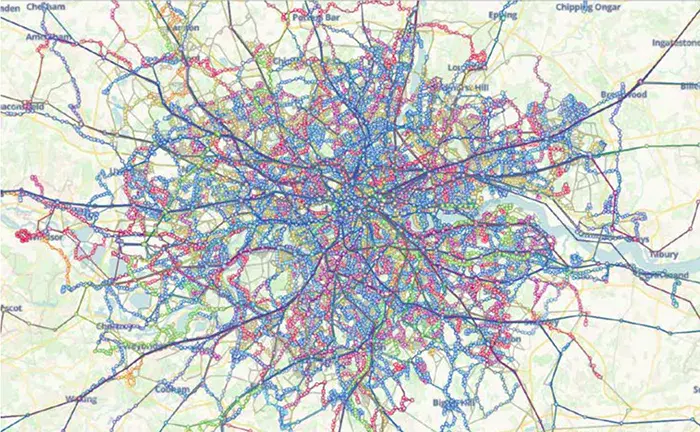
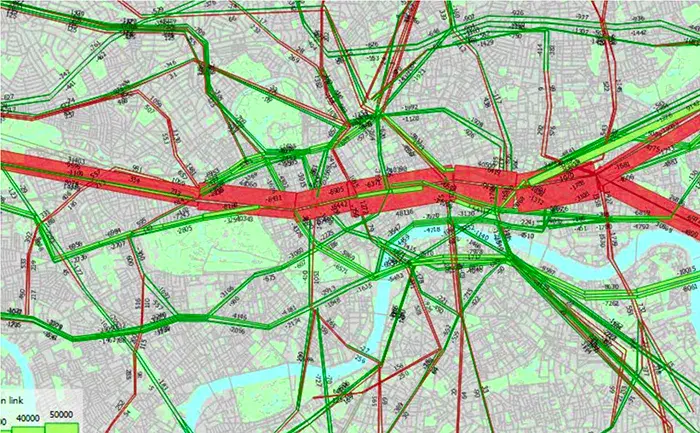
TfL’s Railplan models the likely route and service choices of public transport users to inform outcomes such as anticipated ridership, crowding, distance traveled, and time taken. Railplan incorporates all the services that TfL provides, as well as includes an extensive pedestrian network to represent access to the public transport system and transfer between services. Railplan can predict the rerouting and crowding effects of changes to services or infrastructure and is used to compare the impact of alternative transport provision or land uses, including public transport to and from different locations, the number of people using stops and stations, crowding within public transport vehicles, total passenger travel time and distance traveled by mode.
“Bentley OpenPaths EMME’s backwards compatibility have allowed years of forecasts to be consistently assessed and the drivers of variation to be explained. The software is adaptable, allowing the development of solutions to problems that include modeling high-speed rail and different fare/quality structures,” said Warner. The ability to quickly make changes proved more important than anticipated, including in the wake of the pandemic. “Increasingly quicker assignment procedures through Bentley OpenPaths EMME’s multi-threading capabilities allowed rapid re-evaluation to unexpected uncertainties, such as the pandemic and changing project timescales/scope,” said Warner. When a constrained budget and opening delay, along with the pandemic, meant examining the removal of new stations from the final route, the team was able to quickly test alternatives and then identify which passenger groups needed to be informed. “Without the efficiency and stability of the Bentley OpenPaths EMME software, developing a model as large and as sophisticated as Railplan simply wouldn’t have been possible,” said Warner. TfL also used Bentley OpenPaths to reassess phased opening proposals over a 12-month period. The team was able to revise the plan so that they could get started six months sooner, as well as increasing demand by 12 million passengers.
Accurate Planning For Optimal Delivery
By using Bentley OpenPaths EMME to power Railplan, the planning team was able to update forecasts over thirty times since 2011 against a range of changed assumptions. “The accuracy and reliability of Bentley OpenPaths’ forecasts, including Elizabeth line demand and transfers from existing rail and bus corridors, has resulted in a 200 million passenger forecast that is within 10% of actuals, and ensured that we have a network optimally delivered for today’s needs. This has created a forecasting and appraisal benchmark for speed and accuracy for future projects,” said Donovan.
Ultimately, the Elizabeth line has transformed how passengers use public transport within London, bringing an additional 1.5 million people within 45 minutes of Central London, alleviating rail network congestion. TfL also forecasts 10 million fewer car journeys per year, reducing traffic congestion and road accidents, and provides a net reduction of 24.6 million fewer grams of carbon emissions per day. The line’s construction has boosted the local economy, with 96% of contracts awarded locally within the U.K. and creating 1,000 apprenticeships. “Railplan has a crucial role in planning the provision of public transport in London. The use of the tool spans tactical tasks, such as informing alternative provision during planned closures, to the most strategic, such as informing the development of mega infrastructure projects,” said Stefan Trinder, principal transport planner at TfL. “The flexibility of the software Railplan is built in means it can be adapted for ever-more use cases