

Dublin, Ireland
Dublin Fire Brigade Turbocharges Efficiency for Pre-incident Planning by 80%
iTwin® Technology Provides Unprecedented 3D Model of Complex Infrastructure Across Dublin, Quickly Providing Firefighters with Critical, Actionable Data
Dublin Fire Brigade
Protecting Dubliners Every Day
Every day, the 1.6 million residents of Dublin, Ireland rely on the Dublin Fire Brigade (DFB) for critical fire, rescue, and emergency medical services. The DFB not only ensures the safety and resilience of the built environment of the capital city, but it also serves as a key economic engine for the entire country. The team consists of a staff of 1,000 firefighters and officers who work around the clock.
To support the effectiveness and safety of their jobs, the DFB relies on a process known as pre-incident planning (PIP). This process enhances the incident commanders’ situational awareness and allows their team to make better decisions around the tactics used to fight a fire, contain a chemical spill, or rescue someone from harm. The DFB sought to accelerate PIP so that firefighters could prepare more intelligently, respond more quickly, and work more safely.
When Duty Calls, There’s No Time To Waste
Traditionally, the DFB conducted PIP through tedious, highly manual form-filling activities, such as in-person familiarization visits. Especially as Dublin has begun to construct more complex infrastructure projects, particularly high-rise buildings, the DFB’s capacity to cover all relevant sites and buildings diminished and, therefore, could not scale with the increasingly stringent safety requirements arising across the city. Even once DFB collected data, there were no streamlined methods of disseminating information. Further, the data collection systems that the DFB used were not interoperable with other platforms or technologies.
Due to these immense challenges, the DFB needed a comprehensive solution that could deliver actionable data quickly and efficiently. They sought intuitive, web-based, and device-agnostic insights that enable users to quickly find the critical information required to resolve an emergency as rapidly as possible. These insights required a platform that could link and analyze several heterogeneous data sources, particularly project delivery data from various authoring tools, and information from separate technology systems. They also needed a solution that could incorporate leading methods for representing spatial data and the built environment. In other words, the DFB needed to find the sweet spot between a 3D navigational engine and desktop GIS.
All of this needed to be scalable—incorporating distinct data sources and formats and covering a high volume of subject sites—and interoperable, enabling all users involved to easily connect, manage, and share information regardless of its source, format, scale, or complexity, expanding their connectivity capability.
Key Takeaways
- The Dublin Fire Brigade collaborated with Bentley to build a Digital Twin for Emergency Response (DTER), the first solution of its kind.
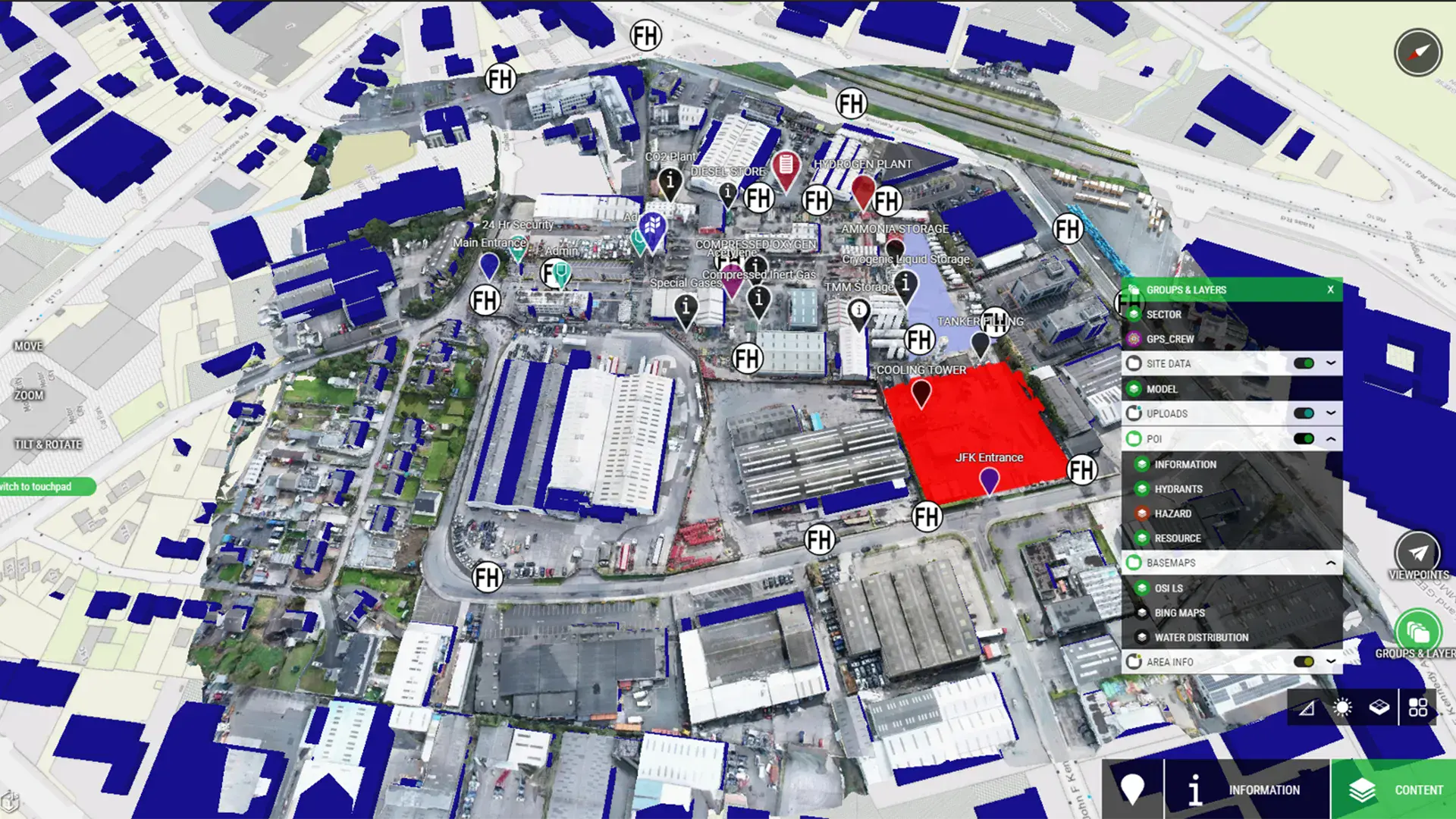
- By using iTwin and OpenCities applications, the DTER integrates multiple heterogeneous data sources, including pre-assembled risk information, critical infrastructure data, personnel location, live drone footage, and incident message logs.
- Bentley’s digital twin solution enabled 80% time reduction for PIP.
- The DTER built on iTwin enhanced usability and expedited information retrieval, so trained officers can locate necessary information in only 12 seconds.
- The DTER enables firefighters to work smarter, faster and safer.
Project Playbook

Putting Out The Fires That Cause Inefficiency
To achieve this urgent and ambitious modernization plan, the DFB needed to thoroughly transform their technology. Given the city’s increasingly complex buildings, the team required a technology provider that could develop a centralized data management system and create digital twins to support PIP processes. They set out to build a Digital Twin for Emergency Response (DTER).
Bentley, specifically its iTwin technology, provided the solutions the DFB needed. DFB utilized Bentley applications to create a first-of-its-kind solution by combining PIP and incident ground management. No other example of digital twins to build resilience, emergency preparedness, and fire incident management as a holistic and integrated product exists.
For the DFB, iTwin technology created a dynamic framework that captured relevant information, arranged in a way that allowed PIP administrators to develop rapid, evidencebased products they need to complete the variety of lifesaving work the team completes every day. Further, iTwin’s intuitive interface enabled rapid upskilling of incident commanders, allowing them to navigate quickly to the required site. The DTER also allows the incident commanders to relay crucial information needed to solve the incident at hand, including pre-assembled risk information (such as the location of hazards), critical infrastructure (such as the location of ventilation controls or protected stairwells), personnel location (via IoT connections to GPS telemetry), live drone camera feeds (via URL link to livestream endpoint), and incident message logs (via the command support logging system).
Interoperable, Centralized Data Saves Lives
For fire departments, time is one of the most precious resources. Bentley’s technology helped the DFB achieve massive time efficiencies. Officers trained on the digital twin for emergency responses now only need 12 seconds to find a designated piece of information. Using iTwin, the DFB realizes 80% time reduction in developing a PIP by creating consistent templates. Further, the platform’s interoperability with centralized data repositories for a portfolio of 3,000 high-risk sites eliminates the time-inducing work to continually keep PIPs up to date.
By improving workflows across three key areas (PIP, incident ground management, and training exercises), the DTER has realized greater return on investment. The DTER has also enabled the DFB to uncover new efficiencies in their resource usage. They now use less energy and water when responding to an event. Most importantly, the DTER serves the community. Faster response times due to better planning minimizes disruption, saves property, and, above all, saves lives. By implementing a digital twin, the Dublin Fire Brigade has made their city safer.