Singapore
PUB Singapore Refines Digital Anomaly and Leak Detection Practices for Their Smart Water Grid Program
Digital Twins, AI, and Machine Learning Drive Intelligent Network Surveillance, Localizing Leaks to Less Than One Kilometer
PUB, Singapore’s National Water Agency
Optimizing Water Distribution Network Sustainability
As part of their Smart Water Grid (SWG) program, PUB, Singapore’s National Water Agency, has been continuously investing in deployment of hundreds of monitoring stations across the city’s 6,000-kilometer underground water network for over two decades. With more than 450 sensor stations for the 24/7 monitoring of potable, treated wastewater, and industrial networks, SWG targets multiple operational efficiencies through real-time monitoring of asset condition, pressure, water quality, and consumption. These sensors help keep the water network running smoothly, but there is still room for improvement to make the system even more efficient and sustainable.
While large-scale burst events are not common in the open streets of Singapore, hidden underground pipe leaks continue to be a problem. To reduce water loss and improve water distribution, PUB launched an SGD 2.3 million SWG anomaly detection and localization project. The project uses real-time analysis of SWG monitoring data to detect and localize leaks and anomaly events, enhance operations and management with hydraulic models calibrated with the monitoring data, and streamline communication with stakeholders and consumers. By integrating smart technology into daily operations, this project makes Singapore’s water network more efficient, resilient, and sustainable.
Manual Surveys, Data Management, And Communication
While permanent sensors provided a good foundation for PUB’s anomaly and leak detection program, the organization still had to carry out costly manual network surveys twice a year. With large amounts of data being collected across multiple sensor devices, PUB also faced compatibility, interoperability, and data management issues. To optimize operational benefits, PUB had to align employee resources with their SWG initiative and address underlying data integration and coordination challenges.
To extract the most information from the collected data, maximize data analytics, and minimize on-site routine network surveillance, PUB sought a smart technology-based, data-driven approach to their anomaly and leak detection practice. They wanted to integrate digital twins with AI and machine learning but needed a technical framework to provide accurate event detection and intelligent water network operations and management. To keep cost low while improving their anomaly and leak detection program, PUB recognized the need for advanced hydraulic modeling and digital twin technology. These tools provide for near realtime insight into the network operations, facilitating predictive maintenance and proactive network management for PUB.
Key Takeaways
- As part of their SWG program, PUB deploys hundreds of monitoring stations across Singapore’s 6,000-kilometer underground water network.
- In 2022, there was an average of 4.5 reported leaks per 100 kilometers of pipe, most of which were underground and hidden.
- Leveraging iTwin and OpenFlows with AI and machine learning, PUB developed their high-fidelity digital twin anomaly leak finder (ALF) solution.
- ALF was benchmarked with historical data to validate its effectiveness, achieving over 80% accuracy in overall anomaly detection performance.
- In the first three months, the digital twin solution identified two operational leaks, alerting surveillance crews and localizing the leaks to less than one kilometer.
Project Playbook

Utilizing AI For A Unique Solution
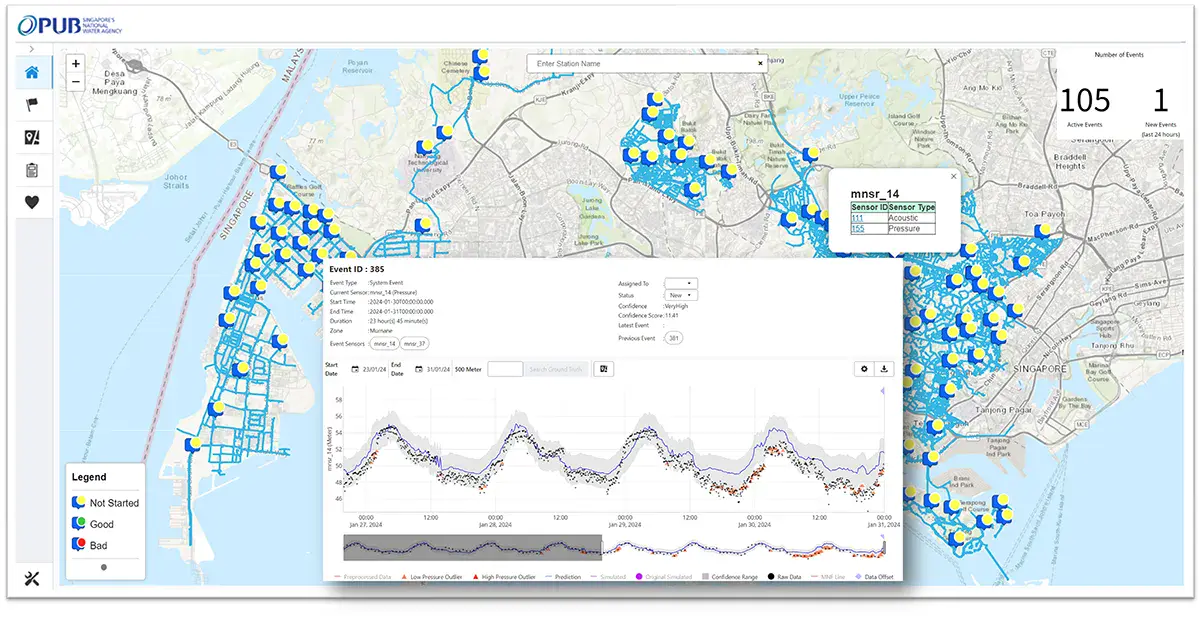
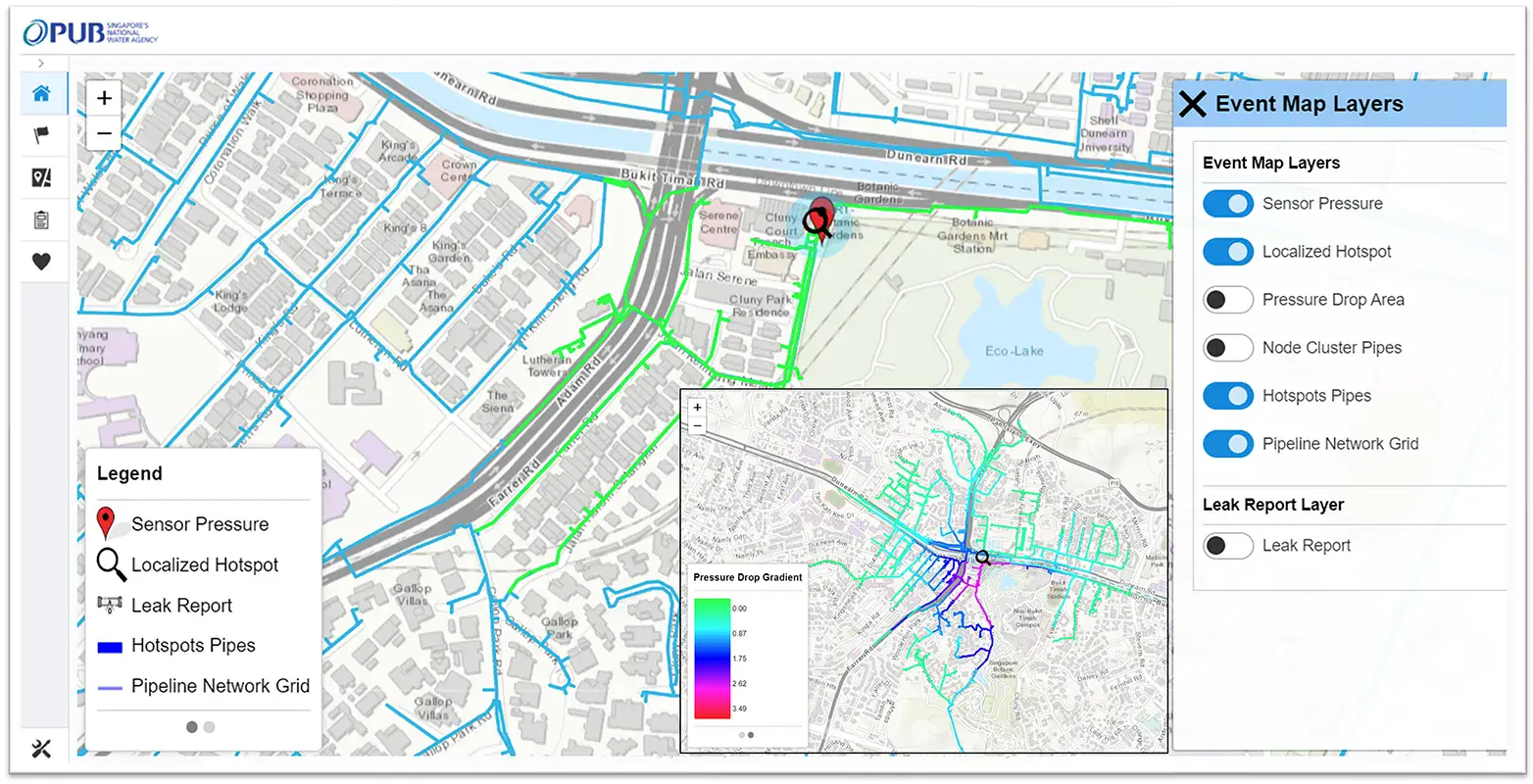
PUB, in collaboration with Bentley, developed an integrated Anomaly Leak Finder (ALF) solution, using hydraulic models recalibrated daily with monitoring data and adaptive high-performance AI technology to generate a high-fidelity digital twin. This approach refined the digital twin, enabling engineers to model and predict flows and pressures, track the health status of different zones, continuously recalibrate and retrain the digital twin, and timely detect and localize various anomaly events, including watermain breaks and hidden leaks. This process provided valuable insight into the network’s operational health. Moreover, the Bentley based, IoT, and intelligent analysis solution provided anomaly detection, especially for hidden leaks and pipe bursts, and located the leaks for field crews.
Having developed their digital twin framework, PUB then deployed their ALF system on Singapore’s Government Commercial Cloud, ensuring high-quality software architecture that embedded the intellectual properties of the predictive algorithms, hydraulic model calibration, and anomaly detection and localization workflow. The cloud-based user interface—coupled with user administration and management and the interoperability of Bentley’s applications—enabled PUB engineers and operators to rely on ALF to perform multiple data-driven, network health-related analytics and tasks to ensure a 24/7 evergreen digital twin.
High-fidelity Digital Twins Drive Intelligent Solutions
PUB’s ALF solution has now been benchmarked with historical data for three supply zones with a total pipeline length of more than 1,000 kilometers, collected by 95 pressure monitoring stations and eight flow meters. A total of 40 weeks of monitoring hydraulic data was used for the benchmark study, resulting in the detection of 45 events, of which 38 were confirmed as true positives, yielding an 80% accuracy in overall anomaly detection performance. As a result of implementing their ALF system, PUB’s field team only needed to search through one kilometer or less of pipelines per detected event, validating the program’s detection and location accuracy and reducing manual inspection time and costs.
Since 2024, two operational leaks have been detected that were verified by field crews sent to investigate them. The major economic gain for the narrowed pool of possible leak events is the reduction in PUB’s scheduled scoping of the network pipes, shifting from time-based to a data-driven form of surveillance, hence reducing total manpower cost. By monitoring the water network using a live digital twin, constantly updated by sensor data, PUB has the best prediction models that will help improve the network’s resilience and sustainability along with water conservation.
This project has redefined the concept of high-fidelity digital twins for smart water grids. While the industry has long embraced smart water systems and digital solutions, PUB’s ALF project has successfully demonstrated how high-fidelity digital twins can augment existing systems through the application of AI, machine learning, and hydraulic simulation models.