Italy
Resilient Built World: Tecne Systra Improves Safety and Sustainability
Bentley’s OpenTunnel® Designer Helped Reduce Project Delivery Time by 21.5%, Saving Nearly EUR 26,600
Tecne Systra
Assessing and rehabilitating italy’s aging tunnels
A prominent organization in the field of tunnel design, Tecne Systra-Sws Advanced Tunneling (Tecne Systra) is the result of a merger between the Tecne part of the Gruppo Autostrade per I’ltalia (ASPI), leader in design of Italy’s motorways, and Systra-SWS, which has made the underground its core business on an international level. The company is focused on developing design intervention projects for Italy’s existing tunnels to improve the safety, efÏciency, and sustainability of the country’s tunnel infrastructure.
Constructed between the 1960s and 1970s, the ASPI tunnels require assessment and rehabilitation of their external linings that must be done in compliance with Italian guidelines for management and risk classification of existing tunnels. Tecne Systra is dedicated to the road tunnel assessment and rehabilitation design, specifically structural renewal and reinforcement of the existing tunnel linings. “The rehabilitation works [will] reduce or eliminate risks of possible hazards due to structural decay and ensure suitable performance in case of seismic events, extending the tunnel lining cycle by constructing new structurally autonomous structures, replacing the original linings, or reinforcing the existing lining,” explained Ana Emiliano dos Reis, BIM manager at Tecne Systra.
With a team comprised of civil, geotechnical, roadway, and hydraulic engineers, along with geologists and drafters, Tecne Systra committed to exploring digital solutions for assessing and designing structural renewal and reinforcement works. “We are dedicated to digital implementation in tunnel assessment and rehabilitation,” stated Emiliano dos Reis.
Manual methods, multiple disciplines, minimizing disruption
Extending the tunnel lining lifecycle required intervention works, ranging from soil consolidation and lining partial demolition, to waterproofing and drainage works and steel mesh and cast-in-place concrete reinforcement installations. The project included investigative surveys to evaluate existing tunnel conditions, as well as provide design, demolition, and reconstruction recommendations.
The main challenges of the project were dealing with the high number of inspections and investigations and survey data, needing to increase the capability of interpretation and valuation of the data and enhance data input accessibility, defining standard procedure for all projects, needing interventions to ensure security safety and renewal tunnel life for 50 years, limiting the impact on highway traffic and optimization of structural intervention and automation, and speeding up operations.
Tecne Systra realized that the success of their digitalization efforts began with the enhancement of data input accessibility for a better decision-making. “The digital project is then developed in different phases according to the construction sequence from demolition of portions of the existing lining up to the reconstruction phase,” added Emiliano dos Reis.
Key Takeaways
FAST FACTS
- Autostrade’s decades-old tunnels in Italy required rehabilitation to ensure their safety and sustainability.
- To extend the tunnels’ lifecycle, Tecne Systra designed interventions on the tunnel linings in the form of structural renewal and reinforcement works.
- Committed to digital delivery, they introduced OpenTunnel Designer to establish a connected data environment.
ROI
- OpenTunnel Designer reduced modeling time by 25% and project delivery time by 21.5%.
- Working in an integrated digital platform reduced time for clash avoidance between structural and waterproofing and drainage collection systems by 30%.
Project Playbook
Establishing a connected digital data and modeling environment
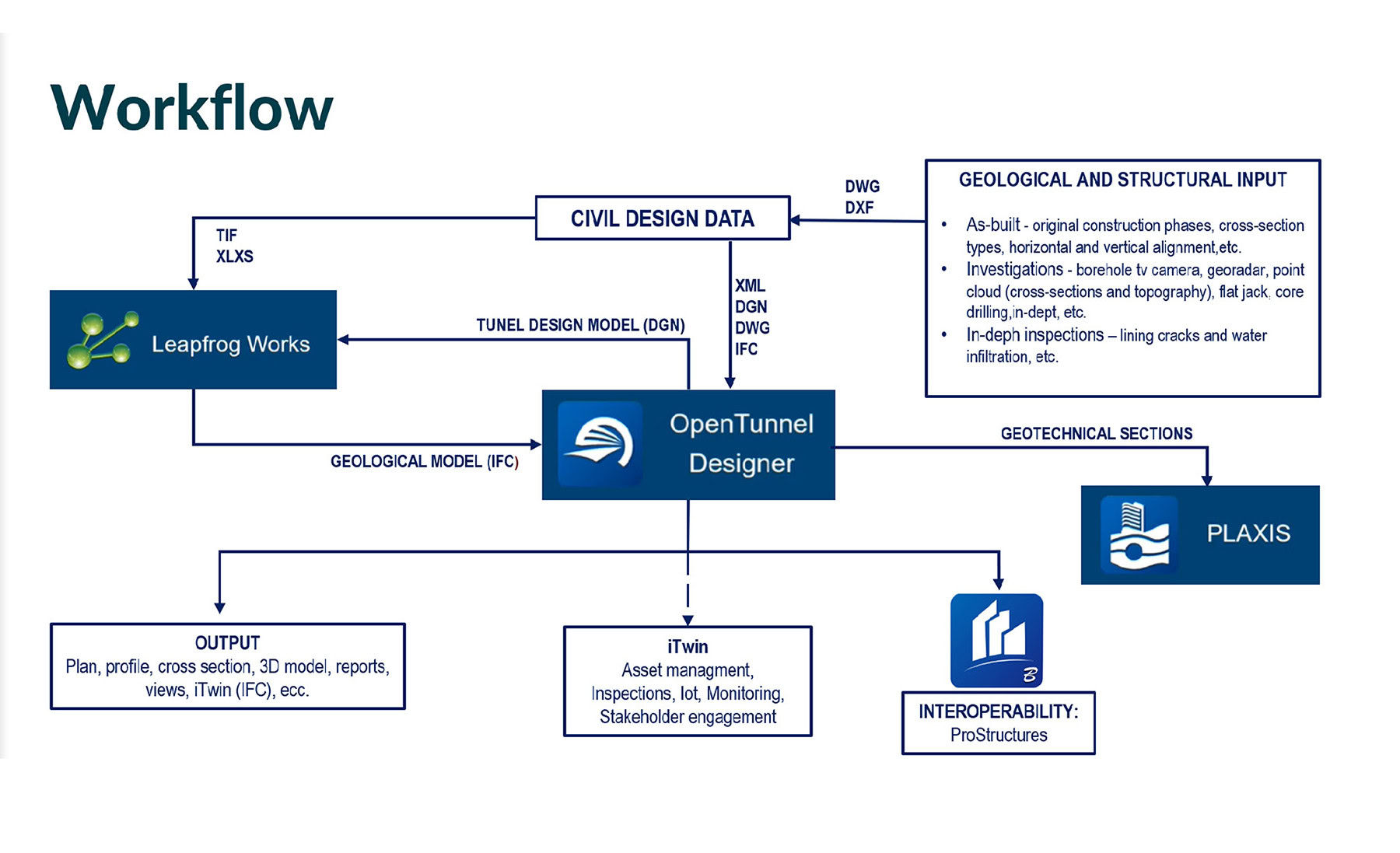
Tecne Systra determined that Bentley applications would allow them to establish a connected digital environment, transitioning to 3D modeling and digital delivery. Introducing OpenTunnel Designer, they developed digital workflows and 3D tunnel models that start with investigative surveys, spanning flat jacks, borehole TV cameras, core drilling stratigraphy, laser scanning, geo-radar, and in-depth inspections. “We have chosen OpenTunnel Designer because it is the first and only purpose-built software for tunnel modeling and design,” said Emiliano dos Reis. Working in Bentley’s open tunnel modeling platform, Tecne Systra combined geological models through Leapfrog, geotechnical models through PLAXIS, steel structural models through ProStructures, and civil models, including water and drainage—all capable of being updated in real time.
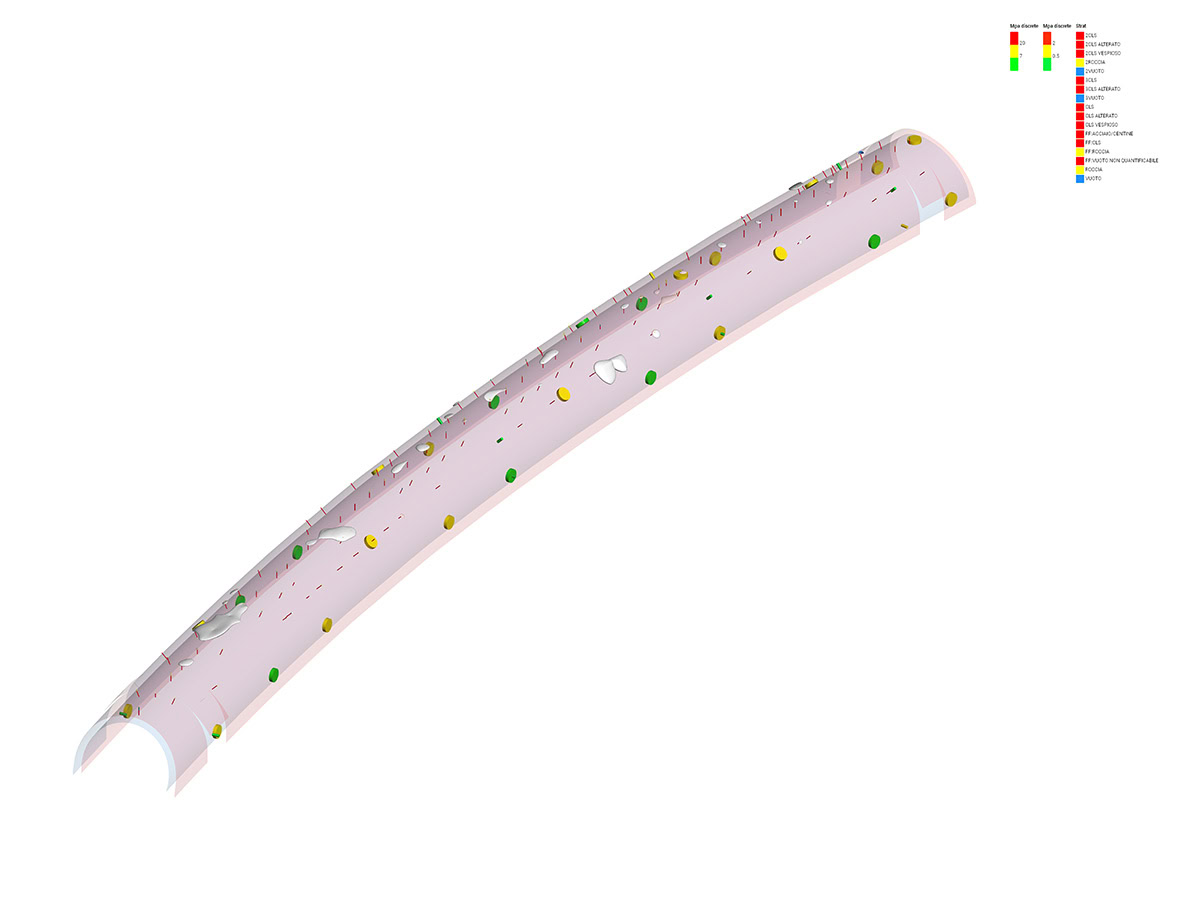
The interoperability of OpenTunnel Designer enabled Tecne Systra to not only leverage data from other Bentley applications, but also from the preexisting horizontal and vertical alignments created with software beyond Bentley. They also were able to export model property sets and work breakdown structures (WBS) through IFC protocols into a third-party cloud platform to collect, manage, and transmit information between project participants. Working in OpenTunnel Designer’s connected digital environment, all team members have access to all project data and information, seamlessly integrating data and workflows to create three comprehensive 3D models: one representing the existing conditions, one for demolition, and for proposed works, essentially constituting an evergreen digital twin. “The existing demolition, as well as proposed information models, represent a database of what existed, what support the design decision, what was demolished, and all the interventions made—soil consolidation, waterproofing and drainage system, steel mesh reinforcement, and cast-in place concrete—that can and should be used as a basis for future interventions,” said Emiliano dos Reis.
Digitalization drives savings and future Lifecycle asset management
“Going digital in the design phase allowed us to increase the capability of integration and valuation for a better survey data interpretation to support design decisions,” said Emiliano dos Reis. The OpenTunnel Designer 3D models saved 30% of the time verifying and interpreting all survey data. The interoperable and automated features of Bentley’s applications helped Tecne Systra streamline workflows, accelerate optioneering and decision-making, and improve design efÏciencies by 20%. Working in a connected digital environment facilitated more efÏcient data exchange and eliminated collisions between the structural design and waterproofing and drainage collection system. Compared to traditional methods, using OpenTunnel Designer reduced project delivery time by 21.5% to save approximately EUR 26,600 in costs.
The adoption of a digital methodology (integrated workflow) allowed Tecne Systra to simulate different scenarios prior to construction, identifying the best design proposal and ensuring reliable design solutions—all while minimizing material waste and material efÏciency. Through digitalization, the company improved the design quality and construction process by increasing collaboration and communication of the design process and giving direct support to the construction site for issues resolutions.
By incorporating an open IFC format into their workflows, Tecne Systra further ensures file compatibility and the reuse of the models and data over time. The design information models with all the interventions data carried out—historically developed using OpenTunnel Designer and Bentley’s engineering-specific applications—provide the foundation for creating a digital twin that can be used for managing multiple types of tunneling data, providing valuable insight into the tunnel’s structural condition to lengthen the asset lifecycle. “The design and construction information model becomes the basis on which it is then possible to implement a digital twin asset information model for facility management in a way to extend asset lifespan, reduce lifecycle costs, and minimize the risks that are associated with asset failure,” concluded Emiliano Reis.