

Singapore
SMRT Trains Improves Rail Reliability across 282 Kilometers of Track
AssetWise Provided the Basis to Optimize Maintenance Decisions
SMRT Trains Ltd
Avoiding Train Delays For More Reliable Rail Network
The first rail operator in Singapore, SMRT Trains (SMRT) operates and maintains over 282 kilometers of rail track in the island country. Since 1987, they have striven to provide safe, convenient transportation services to their commuters. With an average daily ridership of over 2 million people in 2020, SMRT needed a method to keep the tracks in good condition to avoid delays.
Additionally, they needed to ensure that their services were always reliable. SMRT measures the system’s reliability by using mean kilometers between failure (MKBF), where a failure is defined as a service delay of more than five minutes. So, to improve their reliability, SMRT set a target of 1 million MKBF for all their lines. This target is the equivalent of traveling over the entire network thousands of times before seeing a service delay of five minutes or more. However, they were relying on intensive, time-consuming, and manual maintenance planning using tens of millions of data points per year across separate data silos.
Creating A Data Repository With Supporting Analytics
SMRT upgraded legacy processes to improve maintenance strategy so that the tracks stayed in a good serviceable state. They sought to create a data repository that would house all their data in a single location to improve their decision-making, as well as be available 24/7 so that the day and night shift engineers could easily access it.
However, besides the sheer volume of their data, SMRT had different types of data that would need to be imported, including structured and unstructured data. This process would be impossible to manually upload every day to always keep their system up to date. Therefore, they also needed their system to automatically import and convert their data into a standardized data template. Then, the analytics engine would need to analyze the data for maintenance decisions.
Key Takeaways
- As of August 2019, SMRT achieved 1 million MKBF across all rail lines.
- With prioritization implementation, SMRT managed to cut down hundreds of manual planning hours and save about 20 maintenance train deployments annually.
- Moving forward, SMRT plans to continuously improve their maintenance efficiency and effectiveness.
Project Playbook

Developing A Predictive Decision Support System With AssetWise
To enable engineers to make optimized decisions using all relevant data, SMRT used Bentley’s AssetWise Linear Analytics as the basis of their predictive decision support system (PDSS). “PDSS aims to create a data repository designed specifically for us to centralize all the data completely and accurately, as well as a data analytics engine that can analyze the data for maintenance strategy recommendation, resource optimization, and improve maintenance effectiveness,” said Jessie Nguyen, senior engineer at SMRT. The PDSS automatically runs every day to process the data and create a prioritization table. That table shows the planner all the work that needs to be done with a recommended priority.
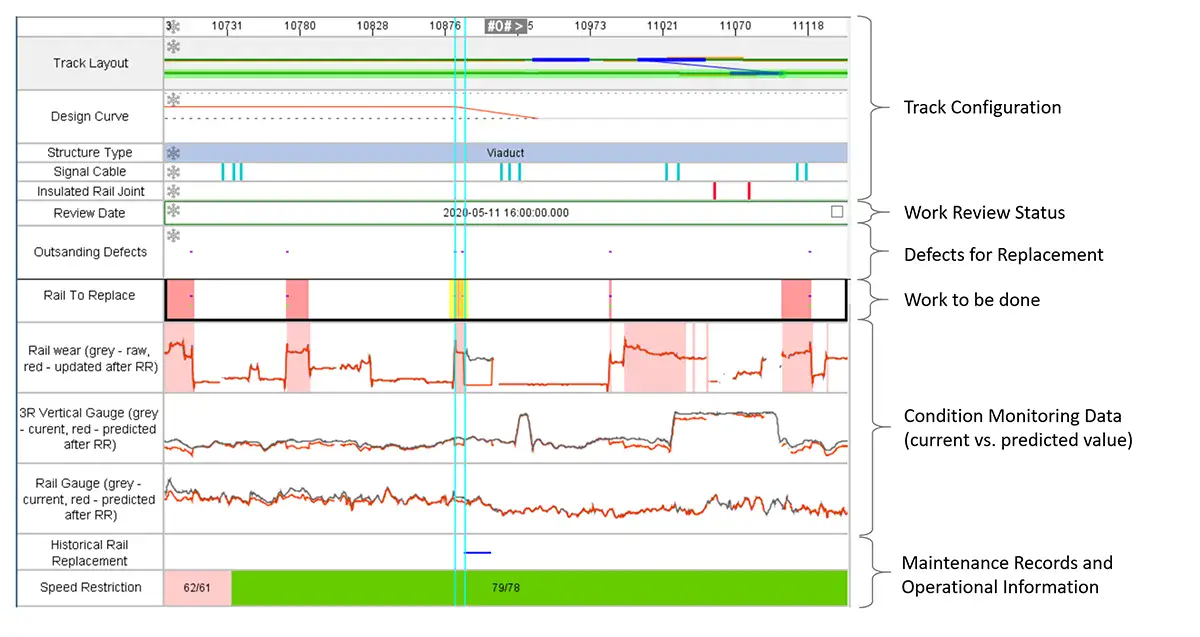
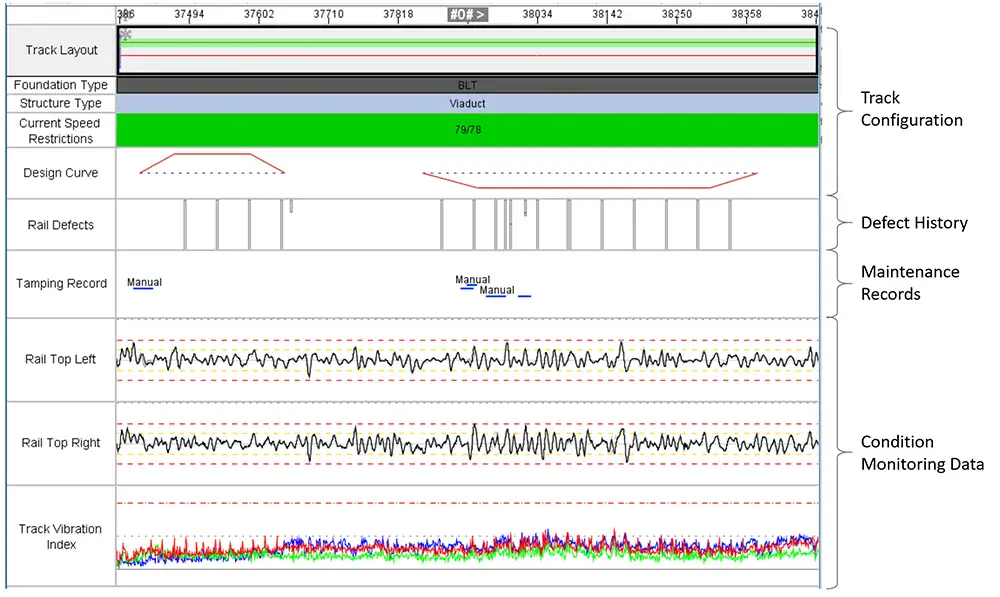
With the PDSS, engineers can visualize multiple datasets in one view to see all the different track subsystems, enabling more in-depth engineering analysis. The AssetWise-based platform automatically pulled four years of SMRT’s data from asset configuration information, inspection records, and operating data. All this information is stored in the cloud via Microsoft Azure, with new information automatically imported into the system. This automation ensures that old data is regularly updated, creating a baseline to perform maintenance. Users can then validate the information before it gets used to alert engineers of relevant work activities. Historic information is also retained, allowing engineers to review the sequence of events leading to the current asset condition.
Additionally, because the PDSS is cloud-based, new users can receive secure access without needing to install any software on their local IT infrastructure. Updates to the solution are automatically made available to the end-user without any actions required on their part. With automatic data processing, analysis, and visualization, users gain greater insight from the data for improved asset condition analysis and hotspot determination.
Saving Planning Time For Faster Repairs And Less Delays
As of August 2019, SMRT achieved their target of 1 million MKBF across all rail lines. Their PDSS enables them to overlay multiple data sources within seconds rather than hours. Data correlation is twice as fast as the existing manual method, while the design allows for easy access to data, significantly streamlining multiple analyses. The table is updated every day and is easily accessible via the web. “Our project has successfully delivered a system that is the centralized asset data repository and a data analytics platform that helps to streamline our engineering analysis. It also helps us recommend maintenance prioritization strategies,” said Nguyen.
Now, SMRT can optimize the efficiency of a work crew’s maximum work capacity during one shift, ensuring the safety and reliability of the rail network. With prioritization implementation, they managed to reduce hundreds of manual planning hours and save about 20 maintenance train deployments annually. Their engineers now have a better idea of the work conditions, allowing them to prepare for the repair work needed in advance to save time on the site. Moving forward, SMRT plans to continuously improve their maintenance efficiency and effectiveness.
“Working on PDSS has been a joyful journey. It continues to help us to maintain our tracks more effectively and efficiently. All we want is for our tracks to be in good condition so that our commuters can travel safely and smoothly every year, every day,” said Nguyen.