Micromobility Modelling in Abu Dhabi’s Strategic Transport Model
SUSTAINABILITY CHALLENGE
One of the 4 Key Sustainability Challenges
Story Highlights
UTILIZED SOFTWARE
Bentley Software
LOCATION
ORGANIZATION/COMPANY
PROJECT SUMMARY
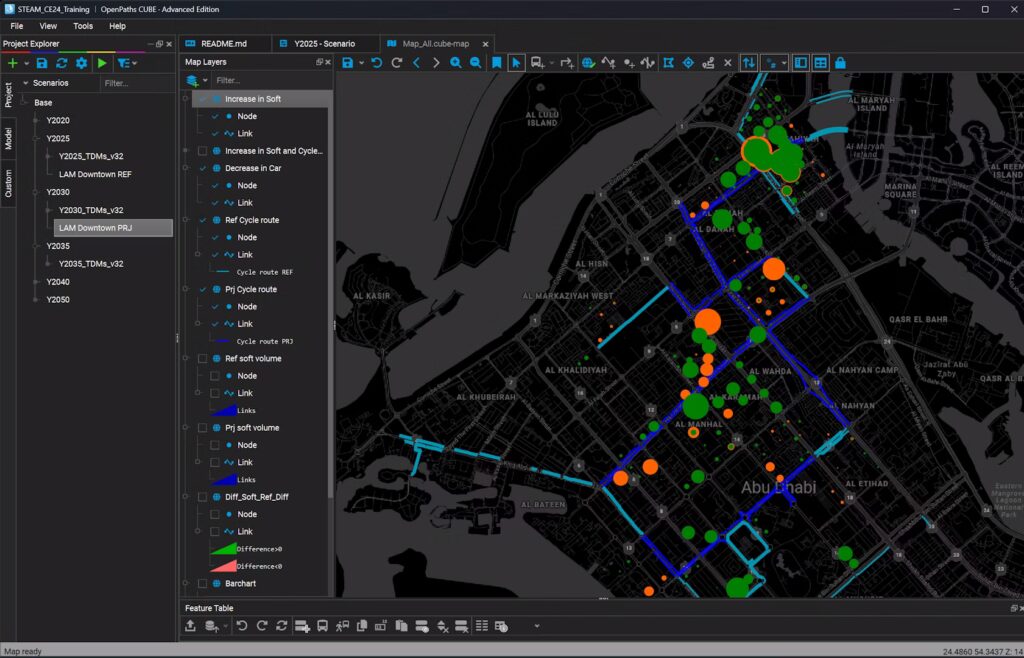
The City of Abu Dhabi faced a challenge: its primary transport model, focused on cars, used large analytical zones that could not accurately capture short trips by bikes or scooters. To make data-driven decisions on new cycle paths and walking routes, the city needed a way to forecast micromobility demand and encourage a vital shift from car use. To solve this, citiME Consultancy LLC utilized Bentley OpenPaths CUBE to develop an automated Local Area Model (LAM). This solution automatically created high-resolution zones and built dedicated networks for cycling and walking routes. Crucially, it incorporated an advanced route choice model, allowing planners to test the impact of policies (e.g., car parking restrictions) to determine the potential shift to active travel. This automation made planning significantly more efficient and evidence-based. The enhanced model is now the foundation for Abu Dhabi’s sustainable planning, directly supporting SDG 11 (Sustainable Cities and Communities): it enables the planning of safe, attractive routes, actively promoting exercise and a shift to active travel modes. It generates data for environmental and cost-benefit analyses, allowing the city to forecast and maximize CO2 reduction and justify sustainable investments. The automated scenario comparison makes decision-making faster and leads to better, more equitable infrastructure planning. The project ensures every new piece of active transport infrastructure is grounded in accurate data, leading to a healthier, more sustainable urban environment.
Relevant UN Sustainable Development Goals (SDGs)
SDG Goal 1
No Poverty
End poverty in all its forms everywhere.
SDG Goal 2
Zero Hunger
End hunger, achieve food security and improved nutrition and promote sustainable agriculture.
SDG Goal 3
Good Health and Well-Being
Ensure healthy lives and promote well-being for all at all ages.
SDG Goal 4
Quality Education
Ensure inclusive and equitable quality education and promote lifelong learning opportunities for all.
SDG Goal 5
Gender Equality
Achieve gender equality and empower all women and girls.
SDG Goal 6
Clean Water and Sanitation
Ensure availability and sustainable management of water and sanitation for all.
SDG Goal 7
Affordable and Clean Energy
Ensure access to affordable, reliable, sustainable and modern energy for all.
SDG Goal 8
Decent Work and Economic Growth
Promote inclusive and sustainable economic growth, full employment, & decent work for all.
SDG Goal 9
Industry, Innovation and Infrastructure
Build resilient infrastructure, promote inclusive and sustainable industrialization & foster innovation.
SDG Goal 10
Reduced Inequalities
Reduce inequality within and among countries.
SDG Goal 11
Sustainable Cities and Communities
Make cities and human settlements inclusive, safe, resilient and sustainable.
SDG Goal 12
Responsible Consumption and Production
Ensure sustainable consumption and production patterns.
SDG Goal 13
Climate Action
Take urgent action to combat climate change and its impacts.
SDG Goal 14
Life Below Water
Conserve and sustainably use the oceans, seas and marine resources for sustainable development.
SDG Goal 15
Life on Land
Sustainably manage ecosystems, combat desertification, reverse land degradation, & halt biodiversity loss.
SDG Goal 16
Peace, Justice and Strong Institutions
Foster peaceful & inclusive societies, ensure justice access, & build effective, accountable institutions at all levels.
SDG Goal 17
Partnerships for the Goals
Strengthen the means of implementation & revitalize the Global Partnership for Sustainable Development.