

NOV 23, 2026
Carbon-in-Mind Design: AI Agents Help Engineers Shape a Project’s Footprint Before It Sets
Carbon is usually counted when a design is finished. Tools in development at Bentley estimate it within minutes, while structure or material can still be changed.
By Sean O'Neill
Key Takeaways
- Bentley Systems is harnessing new AI capabilities to make carbon impact accessible in the earliest stages of an infrastructure project.
- The Bentley project team is teaching AI how a job must be done, resulting in a skill that the AI agent can follow.
- Several Bentley users are now testing the technology.
You know that feeling of spotting a mud puddle on the ground a split-second too late, when your weight is already committed to the step? You can attempt a hasty adjustment, but that foot is coming down more or less where it was already going. That’s where infrastructure project managers often find themselves when they discover their project’s estimated carbon footprint, says Diogo Arezes, sustainability technology manager at Bentley Systems. “By the time they start to quantify the embodied carbon of their project, most of the key decisions around site selection, design, and materials have already been made.” A foot accompli, if you will.
But what if you could see the likely carbon impact while your project was still on the drawing board? How much carbon would be embodied in the concrete, steel, and other materials of a road or bridge, and how that could be reduced by alternative design options. What if you could know all of that information within minutes, with just a few simple instructions?
Getting smarter about carbon
An interdisciplinary team at Bentley is harnessing new AI capabilities to make carbon impact accessible in the earliest stages of an infrastructure project. “We’re connecting the design, the engineering analysis, the sustainability data, and environmental context, so carbon impact can be built into decision-making, not just reporting,” says Louis-Martin Losier, a senior product manager at Bentley.
That's the core message the Bentley team has been sharing during this year’s United Nation COP31 gathering in Antalya, Turkey. The team also opened early access to the tool.
Today, working out the embodied carbon means extracting the quantities of materials in a design and searching a database, such as One Click LCA, to find the right emission factors. For a complex project, doing that right can take days, Arezes says. That’s why it’s usually done once, on the mature design, when the door has already closed on other, equally good design options whose carbon footprint may have been less.
Arezes and Losier, along with their engineering colleagues and Bentley’s own subject matter experts, are developing the new tool based on AI agents and Model Context Protocol (MCP) servers, which let those AI agents work directly inside MicroStation, Bentley’s design software, and other solutions. They work with external data such as One Click LCA’s emission factors and data tables from the Intergovernmental Panel on Climate Change.
The team teaches the AI how a job must be done, and the result is a skill that the AI agent can follow. “When you blur that line between the product managers and the subject-matter experts, and have the ability to create and develop this type of solution directly using AI tools, it’s a huge advantage,” says Arezes. “We know the exact hurdles that sustainability teams in engineering firms face.”
A material difference
Working out the carbon embodied in a structure’s materials involves measuring every element in a design and matching each material to an emission factor, which is the carbon released for every unit of that material produced. A design model holds one half of that equation: the volume and material of every part of the design. One Click LCA holds the other half: a database of emission factors. How to get them talking? Arezes and Losier put an AI agent between them. The agent reads the model through MicroStation’s MCP server and queries the database through a second one, a beta MCP built by One Click LCA.
In practice, an engineer types a request into an AI agent’s chat window. “It’s as simple as saying, ‘Analyze the infrastructure I have open in MicroStation and quantify the carbon emissions,’” Arezes says. The AI agent extracts the volume and material of each element, proposes an emission factor for each, and multiplies the two. Once the engineer has approved the figures, the agent writes them into the item properties of each element, so the carbon data persists in the MicroStation model. It can color the model as a heat map of embodied carbon and produce a report or spreadsheet that also records the assumptions behind each figure.
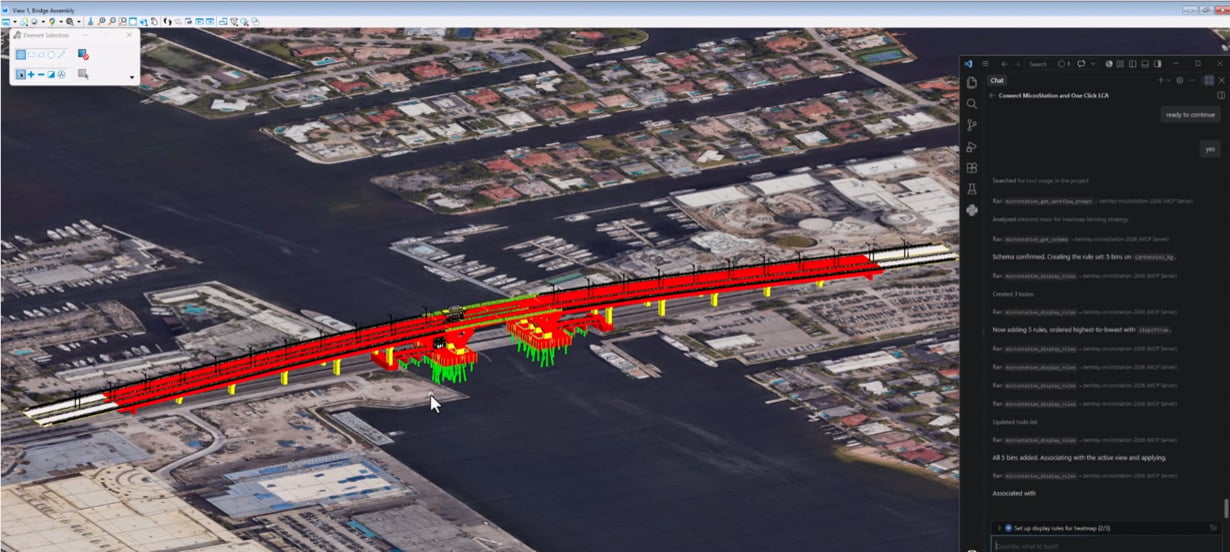
Bentley's MicroStation MCP and Beyond Materials conduct a full carbon analysis on this bridge model through simple conversation, giving engineers embodied carbon estimates within minutes.
Bentley experts developed AI skills that tell the agent what to do. These skills form a package that the team provisionally calls Beyond Materials. “We divide the skills into two aspects,” Arezes says. The first is tasks with a definite answer, such as extracting the quantities of materials. “If you ask a hundred engineers to quantify the materials, the result should be the same,” he says. For such deterministic aspects, the agent triggers a Python script.
The second aspect is choosing emission factors, where there is some subjectivity. Here, the model recommends a factor, and the engineer accepts it or picks another. “You can just say, ‘No, this isn’t C30/35 concrete; this is C40/45,’ and the agent will search the One Click LCA database and find the right emission factor,” says Arezes.
The model is told not to guess. “That’s clear in the instructions we give,” Losier says. If a MicroStation model element has a surface area but no thickness, for example, it asks the engineer to supply one. “We’ve added guardrails for the AI: Don’t move further if you don’t have good-quality information.”
A skill that goes further in the Beyond Materials system hunts for promising alternative materials with lower embodied carbon and, ideally, lower cost.
Toward the entire project lifecycle
A selected group of Bentley users is now testing the Beyond Materials workflow. The goal is to widen access to all users of MicroStation and Bentley’s other design applications in 2027. Firms without a license for Claude or ChatGPT will be able to run the same process from an add-in inside MicroStation, using Bentley Copilot.
For firms that design in Bentley software, this brings carbon into planning and design, long before the final report. The embodied carbon calculations would be no different for a bridge, a road, a building, or a water treatment plant. The Bentley Sustainability team intends to extend the add-in from MicroStation and other Bentley engineering software. Firms with their own emission-factor or cost data can use that instead, Arezes says.
Because the work is done through an AI agent, carbon data is no longer confined to the design team. “Until now, when you used MicroStation, you needed to know what buttons to click,” Arezes says. “Now, with a chat window, you can simply ask questions or request modifications.” That brings in sustainability teams, along with finance departments weighing carbon against cost.
There’s much more to carbon emissions than materials production, of course. The land and vegetation disturbance and the energy used in construction are not yet included in these analyses, nor is the operational carbon from running and maintaining an asset once it is built, or the transport of materials to the site. “Not yet,” says Losier, “but we’ll get there.”
Optioneering, with carbon built in
Swapping a material could lower the carbon of a design that already exists, but a different design altogether might lower it further. Engineers call the search "optioneering”—working up several designs for the same job before choosing between them. With AI, says Losier, “you don’t need to wait months to have all the options.” As an internal proof of principle, Christos Aloupis, a structural engineer and product expert in Bentley’s STAAD.Pro team, has tested whether an AI agent can generate those options and count their carbon at the same time.
“Say we have to build a bridge of a hundred meters,” Aloupis says. “We could have a concrete deck with steel beams or concrete beams. It could have two huge beams or four smaller ones.” Aloupis connected an AI agent to STAAD.Pro, Bentley’s structural analysis software, through its MCP server, and he asked it for ways to build such a single-span bridge to meet a set of requirements, including the distance to be spanned and the number of traffic lanes. The agent proposed four structures in outline, each with estimated sizes and a rough carbon figure.
None could be taken on trust; the sizes were estimates, as an engineer’s first draft might be. “If we have a 90% accurate design, that’s not good enough,” says Aloupis. “If you cross 10 bridges on your way home, you are not fine if nine of them are fine.” Aloupis had the agent build each proposal as a model in STAAD.Pro and run the software’s structural checks, which calculate the load every element must carry and compare it with what the element can bear. The results showed which designs needed strengthening and which were carrying more material than necessary.
These checks also produced the carbon figure. Once STAAD.Pro had sized the elements, the AI agent passed the material quantities to One Click LCA through the same MCP used by the materials workflow. The engineer can then weigh each option’s carbon against its cost and the other constraints of the site.
Whether the choice is material or the entire design, the lowest-carbon option will not always be the right one. “It’s a balance,” says Losier. “A structure with a bigger carbon footprint that lasts 100 years may be a better choice than one with a lower footprint that lasts 50.” But engineers can only strike that balance with the numbers in front of them. What Bentley’s AI tools will change is when those numbers arrive—while there is still time to choose where the foot comes down.