

AUG 31, 2026
Sinelec’s new predictive traffic model supports smart motorway management of Italy’s A4 Milan-Turin freeway
Leveraging OpenPaths DYNAMEQ for short-term forecasting optimizes decision-making to improve traffic flows, safety, and roadway resilience
6 MIN READ
Overview summary
- To support smarter, more sustainable
network management, Sinelec sought to
integrate a predictive traffic model into
their SINCRO traffic monitoring platform. - Working with citiEU and Polinomia, they
developed a system capable of analyzing
traffic conditions, forecasting short-term
scenarios, and supporting operational
decision-making. - Using OpenPaths DYNAMEQ provided
the dynamic modeling and simulation
features necessary for accurate, reliable
short-term forecasting.
Smarter motorway management
With more than 20 years of experience delivering technology solutions for motorway operators, Sinelec is actively involved in digitalizing Italy’s transport infrastructure. Their SINCRO traffic management platform has allowed Italy’s roadway operators to
monitor, manage, and respond to traffic conditions, incidents, and emergencies in real time. The company is now expanding their system’s capabilities to enable intelligent, proactive network management, helping operators anticipate congestion, respond before traffic conditions deteriorate, and improve traffic flow and roadway resilience.
To support the transportation sector’s transition to more sustainable and connected mobility, the Italian government launched its Smart Road initiative, mandating that roadway operators implement a predictive decision-support system. “The Smart Road governmental initiative mandates Italian motorway operators to implement tools capable of generating short-term forecasts with 15-minute interval updates,” explained Sebastiano Spanò, head of business and project management unit at Sinelec.
To help motorway operators meet the government mandate, Sinelec worked with citiEU Consultancy and Polinomia to develop a predictive traffic modeling solution that could be embedded into SINCRO. The project involved creating a dynamic traffic assignment (DTA) modeling system to generate short-term traffic forecasts along the 125-kilometer Milan-Turin motorway at 15, 30, and 45-minute intervals. The model forecasts traffic conditions, anticipates congestion before it develops, and provides decision support to minimize the potential impact on traffic flow from events and changes in traffic conditions—such as demand, lane closures, and weather. By integrating the predictive digital forecasting module into SINCRO, the team transformed Sinelec’s platform from a realtime traffic monitoring tool into a proactive, intelligent decision-support system, enabling A4 Milan-Turin roadway operators to implement safer, smarter motorway management practices.
Integrating multiple data sources, delivering reliable forecasting
To develop the proactive motorway decision support system, the team not only needed to predict traffic volumes, but also needed to accurately simulate traffic behavior under varying roadway operating conditions while generating reliable forecasts in short-term intervals. “The project aimed to develop a DTA modeling system… to obtain data from various sources along the motorway, provide real-time information on motorway performance, and offer short-term forecasts,” said Alberto Brignone, director at citiEU. This involved integrating multisourced historical and real-time data while maintaining the modeling speed and accuracy necessary for reliable short-term forecasting.
Once the data was collected and organized, the team needed to ensure the digital model could provide details on queues, traffic conditions, and all pertinent information essential for driver awareness. Additionally, to allow operators to make proactive decisions and avoid traffic congestion, the model had to consistently simulate how things like changing demand, lane closures, incidents, and weather conditions would affect queues and traffic flows along one of Italy’s busiest freeways. To meet the data integration challenges, deliver fast and accurate predictions, and model complex, changing traffic conditions, the team needed an advanced traffic simulation and dynamic DTA digital application.
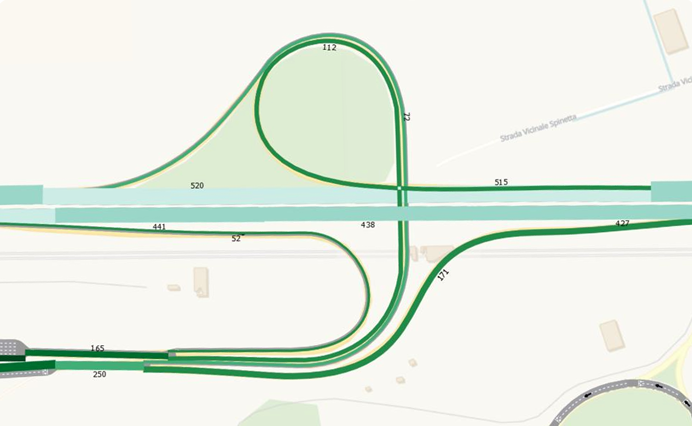
To support smarter, more sustainable network management, Sinelec sought to integrate
a predictive traffic model into their SINCRO traffic monitoring platform
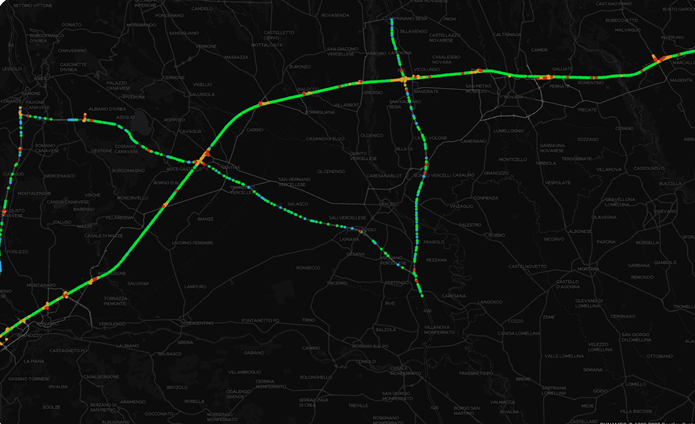
Working with citiEU and Polinomia, they developed a system capable of analyzing traffic
conditions, forecasting short-term scenarios, and supporting operational decision-making.
 " Working with citiEU Consultancy and Polinomia, and using Bentley’s OpenPaths DYNAMEQ software, we were able to implement a system capable of analyzing traffic conditions, forecasting short-term scenarios, and supporting operational decision-making." — Sebastiano Spanò, Head of Business and Project Management Unit, Sinelec
Leveraging OpenPaths DYNAMEQ for predictive traffic modeling
The team selected OpenPaths DYNAMEQ to integrate historical and real-time traffic data with advanced analytical modeling to develop a predictive traffic model for the A4 Milan-Turin highway. The model combines both toll and non-toll motorway sections by using two primary data sources to obtain the data from each section. “We used daily analytical flows data for the tolled section of the motorway, and TomTom data for the un-tolled section of the motorway,” said Brignone. Based on this dual-data approach, the team used Bentley’s application to construct detailed demand matrices that accurately reflected changing traffic patterns across different vehicle types, days, and time periods for all roadway sections. These demand matrices provided the foundation for the short-term forecasting methodology,
continuously predicting traffic demand using realtime data.
“The short-term estimation methodology uses the demand matrix to predict traffic demand over the estimation period based on real-time data. This procedure iterates between demand adjustment and simulation to generate the best estimate of short term demand,” specified Brignone. By incorporating information organized at 15-minute intervals, the model can then predict spikes or unusual variations—such as accidents or reduction in network capacity—that could significantly impact traffic flow.
Integrating the historic traffic data to assess how queues and congestion develop during critical events continually improves the forecasting accuracy of the simulation model through ongoing model calibration and validation. “This process leverages the extensive capabilities of OpenPaths DYNAMEQ, a vehicle based traffic simulation and dynamic traffic assignment that offers a unique combination of realism and computational efficiency, as well as a novel simulation-based demand adjustment procedure, to create a comprehensive traffic simulation for short-term forecasting,” explained Damiano Rossi, CEO and director at Polinomia.
Driving future mobility and sustainability
The interoperability of OpenPaths DYNAMEQ allowed the team to apply this simulation-based forecasting methodology across the entire A4 Milan-Turin motorway. Through its scalability, automation, and lane-based simulation and modeling features, Bentley’s application
offered the flexibility, speed, and accuracy to optimize Sinelec’s digital twin to support predictive motorway practices. “[OpenPaths DYNAMEQ] provides a unique combination of fast computation times, due to the use of a discrete-event simulation algorithm, with a high degree of realism that is well-suited to the requirements of short-term traffic state estimation,” stated Brignone. Unlike traditional approaches, OpenPaths DYNAMEQ’s physics-based traffic simulation achieves optimal and accurate model calibration that shows how vehicles interact along the network, enabling realistic predictions under multiple scenarios for near-real-time decision support and proactive management of Italy’s
A4 Milan-Turin transport network. Embedded within SINCRO, the predictive traffic model now enables motorway operators to forecast events and conditions up to 45 minutes in advance, providing valuable insights to help improve traffic flow, safety, and network resilience, driving smarter more sustainable network operations that support future mobility. “The development of the near real time traffic model for the A4 Milan–Turin motorway represents an important step toward smarter motorway management,” concluded Spanò.
Project summary
Organizations: citiEU Consultancy, Sinelec, and Polinomia
Solution: Dynamic traffic modeling
Location: Milan-Turin, Italy
Project playbook: OpenPaths® DYNAMEQ®