

NOV 09, 2026
Meet the Professor and The Digital Model Keeping The Boy Pharaoh's Tomb From Collapse
Flash floods and swelling shale are threatening Tutankhamun's 3,350-year-old burial chamber. Archeologists and engineers are fighting back with the same technology used to build skyscrapers, bridges and flood defenses.
By Colleen O'Hanlon
Key takeaways
- Devastating ancient and modern floods and changing climate are cracking the boy pharaoh's tomb.
- Digital models reveal hidden insights and work where engineers can't drill or dig.
- Rock bolts could cut ceiling stress by over half.
- The same modeling protects ancient tombs and modern infrastructure.
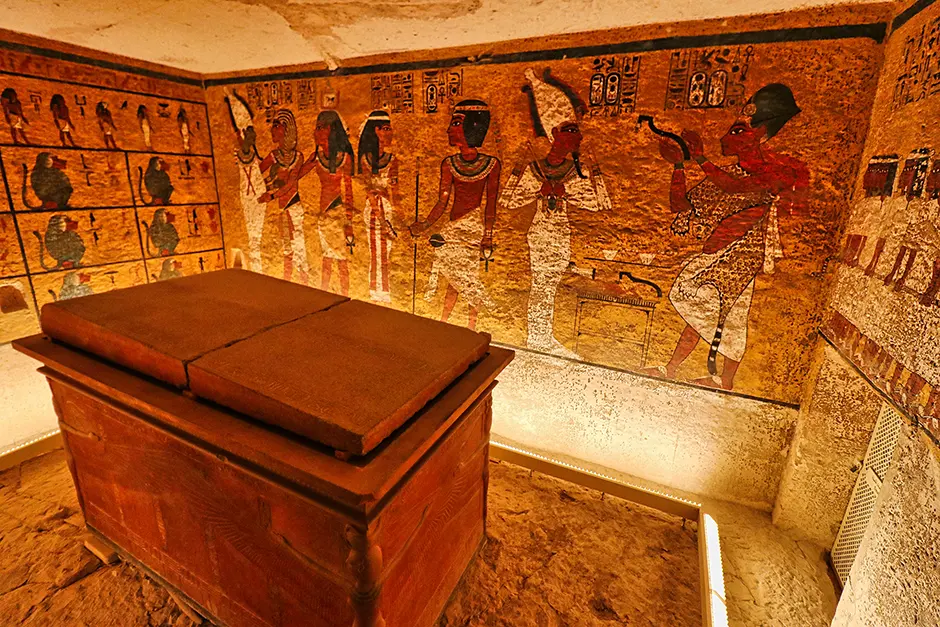
Carved into the fragile shale cliffs of Luxor, in Egypt's Valley of the Kings, lies one of the world's most celebrated archaeological discoveries: Tutankhamun's tomb.
Built some 3,350 years ago, the burial chamber of the boy pharaoh, known as KV62, has captivated the world since its discovery by Howard Carter in 1922. But behind the golden artifacts and painted walls, a structural crisis has been quietly growing for decades, threatening the long-term survival of this ancient site.
Just like the rest of the world, our cultural heritage is not immune to the vagaries of the climate. Flash floods—including a catastrophic deluge in 1994 that sent water, mud and debris into the valley and inundated the tomb—have forced water deep into the soft, moisture-sensitive Esna shale in which the tomb is carved. When waterlogged, the rock is prone to swelling, which has put the priceless structure under increasing strain and widened cracks, including a major fissure that runs across the ceiling of the burial chamber.
Now, similar to engineers making infrastructure around the world more resilient, archaeologists and engineers are using the latest technology and 3D numerical analysis software to ensure future generations can visit the tomb. Professor Sayed Hemeda of Izmir Institute of Technology (IZTECH), Turkey, recently published a study showing how he is using geotechnical engineering software from Seequent, the Bentley Subsurface Company, to build a detailed picture of the structural risks and to draw up a plan for the tomb's long-term preservation. Such tools are especially valuable in places like the Valley of the Kings, where archaeologists and engineers cannot easily dig and drill.
Interestingly, the software, PLAXIS 3D, has its roots in another flood-prone region: the Netherlands. Created in 1974 at Delft University of Technology to help design the Eastern Scheldt storm-surge barrier of the country's Delta Works—a response to the catastrophic 1953 North Sea flood—the finite-element tool grew into a solution now part of Seequent, the Bentley Subsurface Company. It is used worldwide to model how the ground behaves around skyscraper foundations, metro and highway tunnels, flood defenses and many other critical civil engineering and infrastructure projects.
Building resilience in KV62: The structural challenge
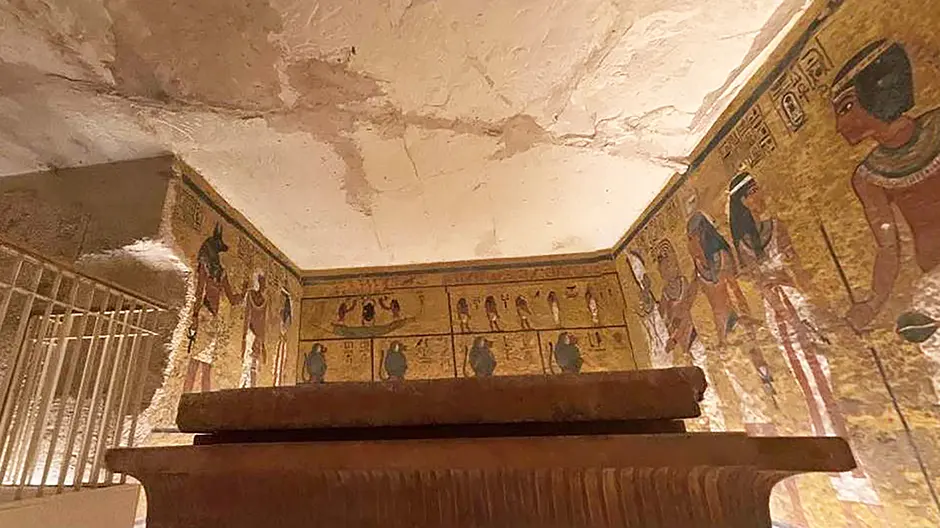
Tutankhamun's tomb mostly managed to evade ransacking by robbers, but nature has been slowly making its way in. Part of the problem is its geological setting. Geologists classify the surrounding Esna shale as "poor" from an engineering standpoint. Over the millennia, torrential downpours and flash floods have found their way inside the rock, raising humidity levels inside the burial site and causing the shale to expand and contract like a dishwashing sponge. This repeated cycle of swelling and shrinkage has progressively widened the fault running through the ceiling of the antechamber and burial chamber—the same ceiling that depicts the famous painted scenes of Tutankhamun's journey to the afterlife. It also doesn't help that the burial chamber is under constant pressure from the weight of the mountain above.
"The combination of a major ceiling fault, water infiltration, and the inherent weakness of the Esna shale has made Tutankhamun's tomb one of the most structurally vulnerable in the Valley of the Kings, because it is excavated in the cliff of the mountains" Professor Hemeda said.
Without intervention, Hemeda warns, further damage to the ceiling could eventually compromise the structural integrity of the chambers themselves—and with it, the irreplaceable wall paintings they contain.
PLAXIS 3D the modeling tool: the archaeologist’s and engineer’s best friend
To assess the tomb's condition without disturbing the sensitive archaeological site, Professor Hemeda turned to PLAXIS 3D and the advanced digital models the software can deliver, including the "Mohr-Coulomb elasto-plastic model."
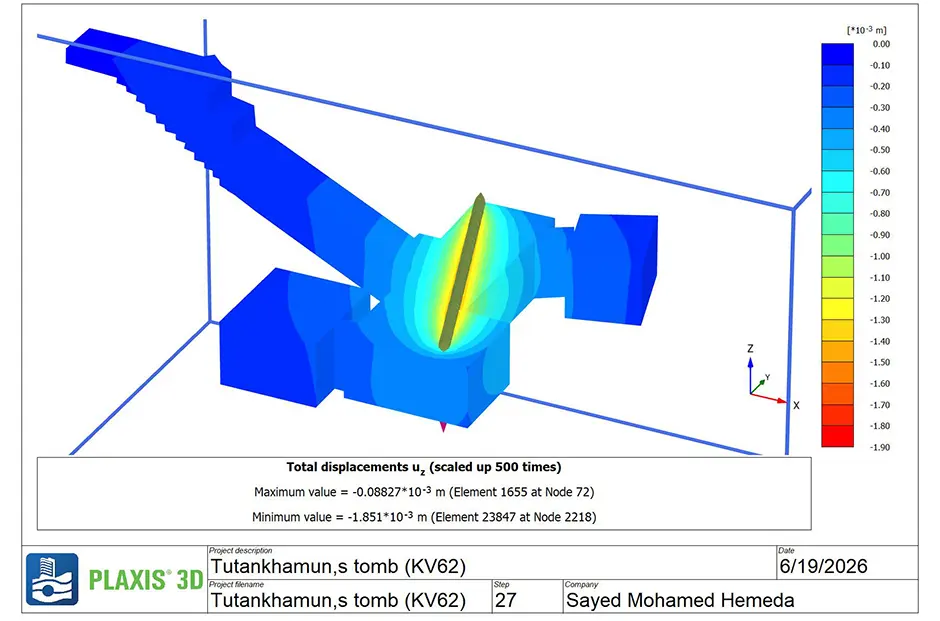
Prof. Hemeda and his team fed data from the site and lab tests into the software. They used it to build a detailed 3D simulation of the tomb that included the burial chamber, antechamber, corridors and the major fault zone intersecting the ceiling. The model allowed them to see and study what was happening to the site structurally, and to choose the best strategy to protect it.
The analysis revealed critical stress concentrations, particularly in the ceiling and crown zones around the major fault. But it also pointed to solutions. By simulating the installation of a rock-bolt reinforcement system and other features, they could see the fix would reduce stress on the ceiling by more than half and relative shear stress by more than 90%, dramatically cutting the risk of shear failure along the fault.
A roadmap for preservation
The model showed that driving bolts into the rock would introduce a minute, calculated amount of movement in the rock mass. This is a good thing. The initial movement "mobilizes the tensile capacity of the bolts," according to Seequent's blog, transforming a series of potentially unstable blocks into a more coherent, self-supporting structure. "The advanced modeling proves that facilitating this safe, controlled deformation is the key to preventing the catastrophic, progressive structural failure that would otherwise occur," Seequent wrote.
Hemeda added: "The numerical model demonstrates a successful transition from a state of high structural vulnerability to one of enhanced stability and safety."
Hemeda proposed two practical support-system options for the antechamber and burial chamber. The study calculates that 23 long, fully grouted roof bolts—each 20 millimeters in diameter, 5 meters long and spaced 1 to 1.5 meters apart—together with wire mesh and sprayed on concrete, would be sufficient to provide the required structural resistance across the exposed area of the chambers. He derived this precise engineering specification directly from the digital model.
The study also established strict movement thresholds for monitoring after installation: a maximum allowable vertical displacement of 1 millimeter over six months, with a warning threshold of 0.5 millimeter in any three-month cycle. These figures give conservators a set of clear benchmarks for ongoing structural-health monitoring, and an early warning system if conditions change.
A solution for posterity
Hemeda's work on KV62 is part of a broader body of research applying advanced geotechnical modeling to cultural-heritage preservation—a field where the stakes could not be higher and the opportunity for physical investigation is tightly constrained. His work has also revealed hidden structural risks beneath Pompey's Pillar in Alexandria. In each case, the principle is the same: where archaeologists cannot excavate and engineers cannot drill without consequence, high-fidelity digital simulation provides the evidence for responsible decisions.
Crucially, the digital simulation techniques used to safeguard these priceless antiquities—predicting subterranean risks before they happen—rest on the same principles used to build resilience into modern, everyday infrastructure across the globe. By understanding the subsurface, engineers can design solutions that withstand environmental pressures and monitor them continuously to protect the tomb's integrity without compromising its archaeological significance.
The boy pharaoh's final resting place has survived more than three thousand years. Modern geotechnical engineering is helping to ensure it survives the next three thousand.
Read more about saving King Tut’s tomb on Seequent’s blog.
Sources:
- Hemeda, S. 3d stability modelling of Tutankhamen,s Tomb (Kv62) using Plaxis 3d with jointed rock model. npj Herit. Sci. 13, 155 (2025). https://doi.org/10.1038/s40494-025-01687-x
- Hemeda, S. (2026). Numerical analysis and validation of rock bolts installation for structural stabilizing of Tutankhamen's Tomb. npj Heritage Science, 14, 304. https://doi.org/10.1038/s40494-026-02668-4
- Professor Sayed Hemeda is professor in Conservation and restoration department, faculty of architecture, Izmir institute of high technology (IZTECH) , Izmir, Urla, Türkiye.