

SEP 29, 2026
From Wind Farms To The Navier-Stokes Math Proof, Bentley Engineers Explore What’s Possible With the Latest AI
Bentley engineers seized on the launch of OpenAI’s GPT-6 Astra to conduct experiments that show where AI-powered engineering workflows are heading.
By Kathleen Moore
Key takeaways:
- Bentley is bringing AI into the infrastructure sector.
- Model Context Protocol (MCP) servers connect the latest models to engineering software.
- Bentley has built MCP servers for MicroStation, STAAD structural analysis software, PLS Power Line Systems, and other solutions—and more are on the way.
Every professional field is changing with AI, and the infrastructure sector is no different. Bentley Systems is embracing the technology to connect powerful, probabilistic AI models with deterministic engineering software—and each new major AI model release sparks a new round of creative experimentation.
The September launch of OpenAI's GPT-6 Astra was the latest spark, inspiring several exciting experiments that show how AI, experienced engineers, and trusted engineering applications like Bentley’s MicroStation can work together.
Acting as a bridge between AI and the engineering software are Model Context Protocol (MCP) servers. These let AI assistants talk directly to engineering applications, allowing engineers to direct workflows in plain English, no coding skills needed. Bentley engineers have already built MCP servers for MicroStation, the company’s STAAD structural analysis software, PLS Power Line Systems, and other solutions. (Read about those experiments with MCP servers.)
Now they’re taking on CAD modeling, urban planning, wind farm design, and even the equations at the heart of one of the world’s toughest math problems. Join our colleagues as they take on four experiments that provide an exciting glimpse into where AI-powered engineering workflows are heading.
(CAD) Model Behavior: AI Project Lights The Way To What’s Next
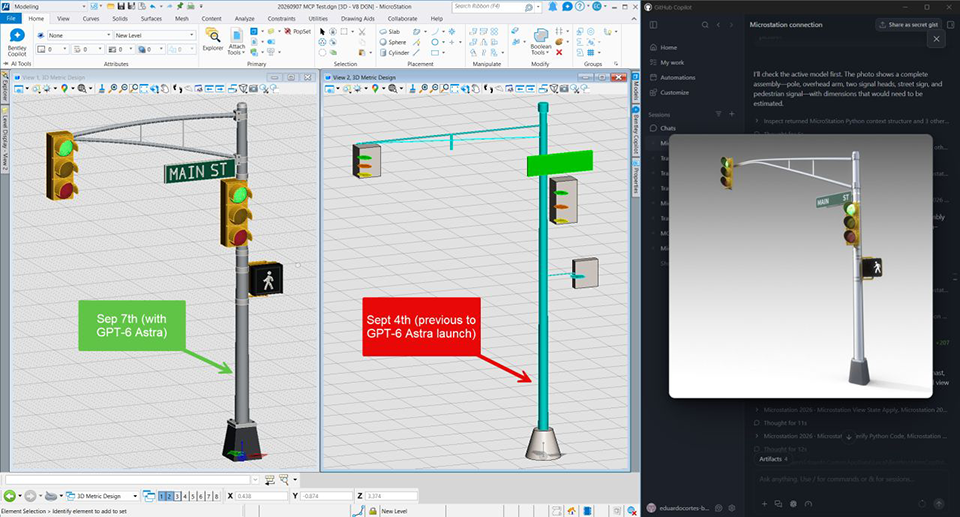
In early September, Bentley engineer Eduardo Cortés ran an experiment using the MicroStation MCP server and an AI prompt. He wrote: "Can you create a model of the traffic light in the attached picture?" The resulting CAD model was rough. Its dimensions were off, its street sign and pedestrian signals were missing, and its traffic lights were flattened into red, green, and yellow dashes. But then OpenAI released GPT-6 Astra, and Cortés again ran the test using the same prompt. This time, the model was far more accurate. “The power offered by GPT-6 Astra lies not only in improvements to CAD model creation, but also in its ability to extract detailed information from images and sketches, as well as the quality of the scripts generated from that information,” Cortés says. “This marks a major difference compared to the models we had tested previously.”
Can You See It Now? Lunch-Hour Experiment Helps Digest London Planning Rules
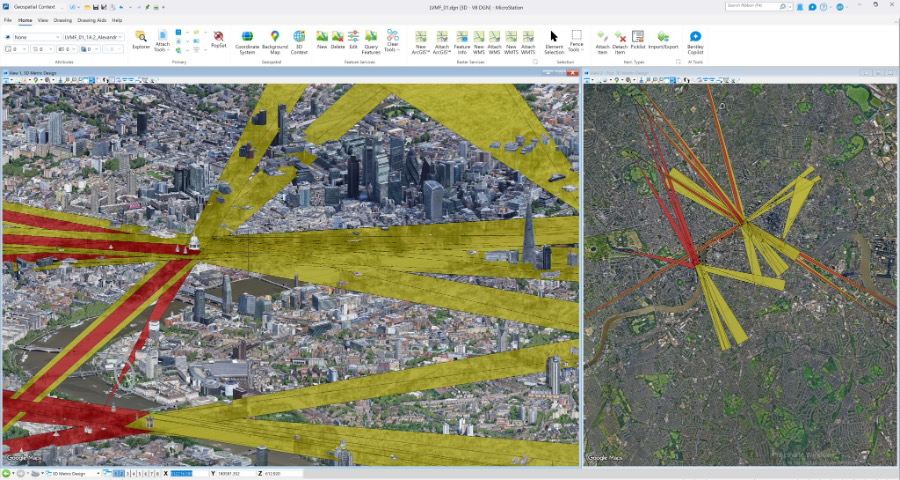
For more than a decade, London planning rules have protected a set of quintessential views of the British capital’s landmarks, including St Paul’s Cathedral and the Palace of Westminster. Every proposed new building must avoid spoiling these views—a process that typically starts with interpreting hundreds of pages of documents and then translating them into a digital model. Bentley’s London office, perched 40 stories high and just a short walk from St. Paul’s Cathedral, has magnificent views of the city. Matthew Felton, a senior product manager at Bentley, wondered if GPT-6 Astra could help protect the views. In his lunch hour, Felton ran an experiment using a combination of Astra, an AI-powered coding assistant, and the MCP server for Bentley’s MicroStation design software. The workflow generated a set of 3D protected vista "volumes" and landmark sightlines that could be analyzed in the context of an actual design project. "The question changed from 'What does this planning policy say?' to 'Show me what this planning policy means for my project,'" Felton said.
The Project Will Blow You Away: An Offshore Wind Farm, Designed Via Prompts
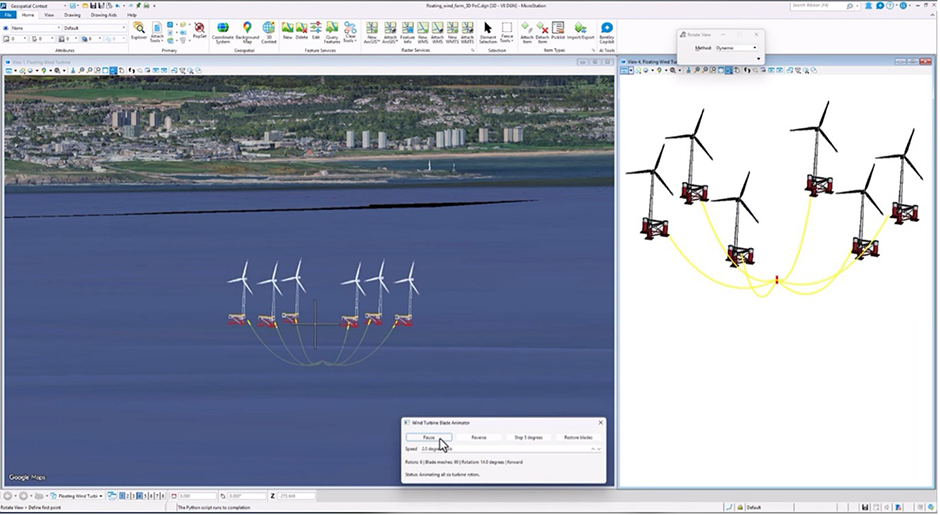
Our next experiment attempted to design an offshore wind farm using a workflow made up of Astra, an AI assistant, MicroStation, and SACS, which is Bentley’s structural analysis and design software for the offshore oil, gas, and renewable energy industries. First, engineer Ata Mesgarnejad used a single reference image and an AI prompt to produce an offshore wind turbine model in MicroStation. He then created a matching structural model in SACS Precede, the software’s interactive graphical modeling and results visualization environment. Eventually, he created an entire wind farm—all without giving the AI agent any dimensions, engineering specifications, or an existing model. Bentley senior product manager Louis-Martin Losier then brought Mesgarnejad's design to life, animating and placing the wind farm in its real-world setting off Scotland’s North Sea coast. Viewing a project like this, in its geospatial context, means engineers and officials can better grasp its scale and any site constraints. Another advantage: Coastal communities can see a proposed development and join the conversation before anything gets built.
Visualizing The Solution To One of Math’s Biggest Unsolved Problems
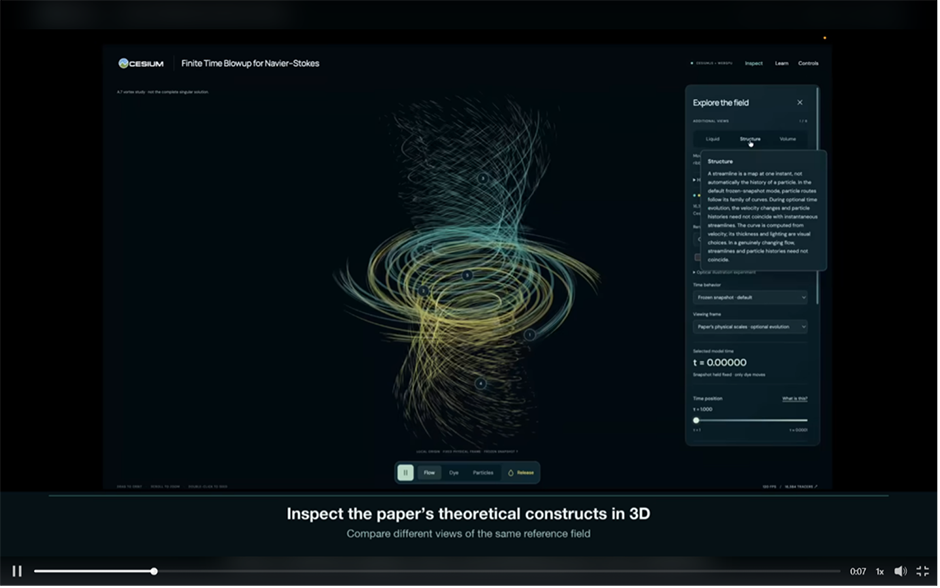
Just days after Astra’s release, OpenAI grabbed more headlines by saying it had cracked one of the toughest unsolved math questions, the Navier-Stokes problem (read about the breakthrough and the ensuing controversy). The Navier-Stokes equations describe the flow of fluids, and they’re used by weather forecasters, aircraft designers, and physicians. For decades, mathematicians have been trying to find out whether the equations ever break down and produce nonsensical answers. This month, OpenAI said the answer is yes, that in certain conditions, a fluid can form a vortex that shrinks and speeds up until its velocity goes to infinity. To see what that could look like, Bentley’s Justin Dehorty took the equations from OpenAI’s manuscript and used Astra and CesiumJS to visualize them. CesiumJS is a modeling technology developed by Cesium, Bentley’s 3D geospatial company.