

OCT 01, 2026
Meet Andy Rahden, the Engineer Driving Bentley's Revenue
Andy Rahden, promoted to chief revenue officer in August, treats revenue the way he reads a racetrack—a closed circuit that turns income into growth and innovation into better solutions for Bentley’s users.
By Tomas Kellner
Key takeaways
- Engineer-turned-CRO found sales by solving software users' problems
- Revenue funds innovation, which serves users and returns more revenue
- AI will reshape how engineers use the software and the way Bentley bills for it
When you sit down with Andy Rahden, whether in his office or in a video call, the first thing you notice is a piece of art on the wall behind him: a framed white loop on a forest green background. It outlines the course of the original Nürburgring, the legendary racetrack that Scottish Formula 1 driver Jackie Stewart dubbed the "Green Hell" for its 22.8 kilometers (14.2 miles) of twisty, misty turns tunneling through the deep woods of the Eifel mountains in western Germany.
In Rahden's world, the image works as a metaphor. Green is the universal color of money, and this summer, Bentley Systems—the Nasdaq-listed infrastructure engineering software company with $1.5 billion in annual revenue—appointed Rahden as its chief revenue officer. He's responsible for increasing the flow of cash into the company's coffers to meet growth and investor expectations, and to fund the innovation that will enable Bentley to stay ahead as AI reshapes infrastructure engineering.
The white loop in the picture is a window into what shaped him. Rahden’s family has engineering roots tied to one of the largest technical undertakings in American history: His grandfather, a metallurgist and Rahden’s most important role model, worked for J. Robert Oppenheimer on the Manhattan Project. As a boy, Rahden held small prototype components of the atomic bomb so he could study the mechanics himself. "Being around him sparked my interest in tinkering and exploring the art of the possible," says Rahden, who restores vintage cars and spends his weekends at the racetrack. "He wanted to understand how things worked, from how you take a radio apart to how your car engine works. This applies significantly to things like business and other things that I do today."
Curiosity as a job requirement
That curiosity, paired with problem solving and a focus on outcomes, has served Rahden throughout his career. At Bentley, he leads roughly 1,600 people, including solutions engineers, global sales and services staff, and technical account managers. The solutions engineers work with software users to understand their problems in depth, then assemble Bentley's products into a combination built for that specific software user. "What you're doing in sales is you're filling gaps, you're filling needs that people have, and you're solving problems for people," he says. "And as an engineer, you really learn how to solve problems. So, it's quite a skillset to marry together."
To do the job well, Rahden says, he has to stay close to software users while working just as closely with internal partners like Julien Moutte, Bentley's chief technology officer, to understand where the company's engineering and strategy are headed. "For me, it's all about connecting the dots: providing value to our accounts, receiving money as a result of driving that value, and then in turn taking that money and allowing all of the other teams, both operationally and technically driven, to do things with those funds that drive innovation," he says. "If you look at it from a shallow perspective, you're talking about just making more money; but if you look at what we do with that money, we're doing amazing things with it."
From Stagg Field to Santa Fe
Growing up in Chicago, Rahden was steeped in science and innovation lore from an early age. But it was curiosity, the trait he picked up from his grandfather, Clarence Markus, that steered him toward engineering and eventually to Bentley. Markus was a precocious student who finished university with an engineering degree at 17. He joined Enrico Fermi's team as they assembled the world's first nuclear reactor beneath the disused stands of Stagg Field at the University of Chicago, achieving the first self-sustaining chain reaction in December 1942. He was later dispatched to Los Alamos, New Mexico, to work on the atomic bomb.
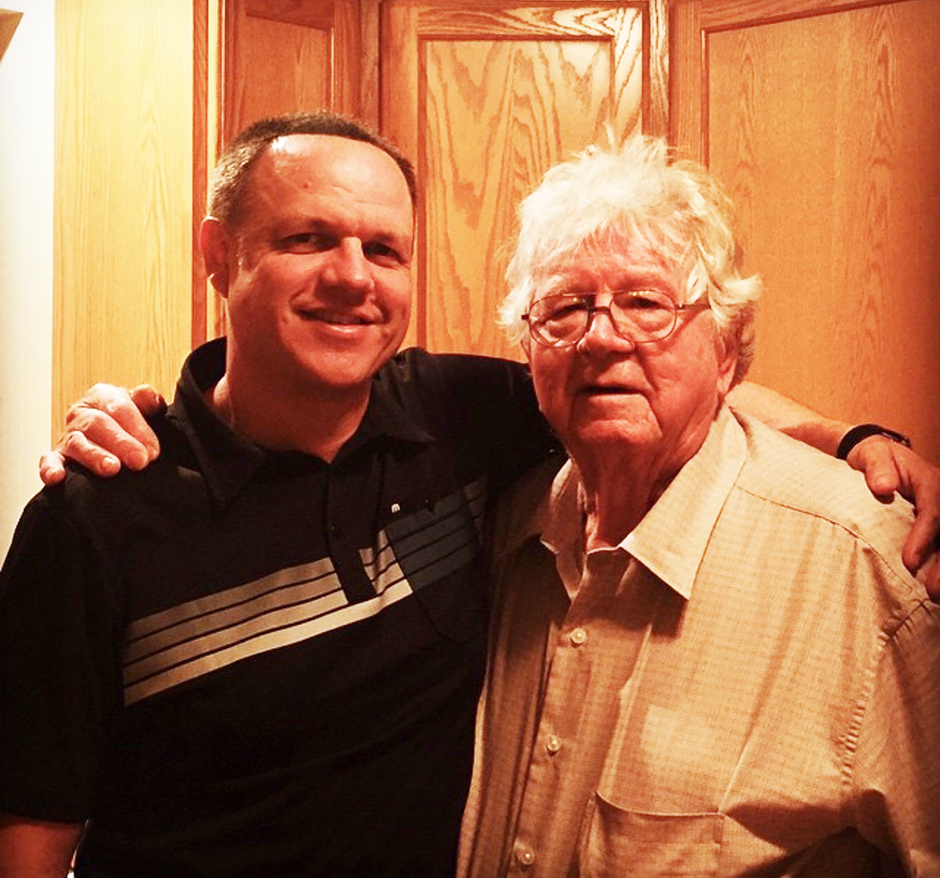
Rahden spent his childhood summers in Santa Fe, where Markus retired and kept building: furniture, jewelry, silver concho belts and buckles fastened with a mechanism he patented. "He was a very big learner and wanted to understand how things worked," Rahden says. "I'd spend most days after school with my grandfather having lots of discussions about different things that he did."
Getting it right the first time
Rahden followed Markus into engineering, earning a mechanical engineering degree from the University of Utah and taking a job with Baker Hughes, the global energy technology company. He joined a team building municipal water infrastructure—rake arms, pressure vessels for filtration systems—components so large they had to be assembled on site. The scale magnified the cost of any misstep. "I saw the mistakes made during the design process that had to be fixed in the field," he says. "You realize how early design choices influence downstream execution, and how critical it is to get it right, so you don't waste time."
That lesson led him to a job as a reseller of SolidWorks, the 3D design software used by mechanical engineers. Rahden came in as an application engineer but soon spent most of his time training customers. "I started recognizing different gaps across how they worked and operated and realized that I had a better solution if I just shared it with them," he says. "And the more I shared those solutions with them, the more they were desirous to utilize that software and to bring it forward."
They were also willing to pay more, and his bosses noticed. When a couple of sales reps left, the CEO offered him their accounts. "It was something I was kind of scared of, especially coming from an engineering background," he says. But he took the plunge and became one of the company's top global reps. "I couldn't have been happier," he says. "I got to work with more people. I got to understand more challenges that people were facing. And I got to solve those challenges through placing software in their hands and really, in turn, selling it to them."
One problem at a time
That experience became the template for the solutions engineering organization Rahden built at Bentley, a far larger company with a sprawling software portfolio that spans planning, design, construction, and asset management. "When we start talking to an account, it's almost overwhelming to talk about how many different problems can be solved because they have so many," he says. He instructs the team to focus on the problems that block users from moving ahead and assemble the products into solutions that vanquish them. "We're out in the world talking to some of the most brilliant designers, engineers, asset owners alike, and we're solving problems for those individuals with solutions that we create so eloquently here at Bentley."
The relationship runs both ways. By watching Bentley software used in the wild, his teams collect ideas the product organization would never have generated on its own. "Oftentimes our accounts utilize the products and solutions that we offer unintentionally to solve other issues that we didn't even know existed," Rahden says. "If we truly understand what they're trying to do with that software, and we figure out how to meet those gaps, we progress forward."
Closing the loop
That feedback loop is the foundation of Rahden's collaboration with Moutte and the technology team. Together they decide where Bentley should invest. "It's just a cyclical thing that can really drive a lot of innovation here at Bentley, where we can invest in new technologies like AI to do things that maybe our software can't do today," Rahden says. "It really is a beautiful thing that we can drive the revenue into the business to solve technical problems and really progress the world forward."
The pace of AI development has that loop spinning faster. Bentley is working with engineering firms to pair powerful but probabilistic AI agents with deterministic engineering software, which cannot hallucinate and must return a predictable answer every time. A bridge that’s 95% correct is a 100% liability.
At the start of 2026, Bentley had built a handful of custom AI solutions for users; now there are hundreds. "The growth of this is exponential, especially as you look over the last 12 months," Rahden says. "We're providing an open environment for people to unlock the capabilities of the technology that we've built over the past years, over the past decades."
Obviously, much is yet to be defined. AI will change not only how engineers use software, but how Bentley charges for it, whether by some existing model or a new one nobody has landed on yet. Compute costs can also exceed the human labor they replace. Those questions occupy much of Rahden's time, but his north star hasn't moved: Start with the user needs and work backward.
That thinking undergirds the upcoming Bentley Tech Summit, a conference for thousands of Bentley software users and other stakeholders that the company will hold next spring in Toronto. It's a first in Bentley's history, and the goal is to build an external community of users and "bring the best and brightest minds together to talk about how infrastructure is developed and created and innovated moving forward," Rahden says.
Weekends in the garage
Rahden finds the energy for all this in habit and routine. On weekdays, he's out of bed before 5 a.m. to exercise and at his desk early. "Having a rhythm is really important," he says. "I really try to ensure that I get in front of my computer before my day of meetings and interactions starts, so that I can really establish some clear thoughts about what I need to get done during that day." He admits he isn't sure when his day ends. But the weekends are where he recharges. "I love restoring cars, but I also just enjoy being around cars," he says. "I love going to the racetrack, either driving on the track or going to watch others race. It's always been something that I'm passionate about."
It's a passion that traces back to his grandfather's workshop, watching him work and trying to figure out how it all fits together.