

MAY 27, 2026
A Bridge in Amsterdam, Seen From a Living Room in Dublin: How Tech from Bentley and Cesium Put Dutch Infrastructure Inside a Flat in Ireland
Verna Porter
Key Takeaways
- Bentley Labs is pioneering XR for built-environment design.
- Up to five users can share one virtual site visit, thanks to Bentley Labs and iTwin.
- The same tech could transform community engagement.
Standing in her home on a leafy Dublin street, Liana O’Cleirigh sees what anyone else would: a red-brown armchair, a desk, and a window view of a neatly trimmed front lawn and the occasional passerby. Then there’s the 3D model of the Earth, spinning above her rug.
When she extends a hand, a virtual menu pops up in the Apple Vision Pro headset covering her eyes. With a pinch of her fingers, the Earth turns and zooms in toward Amsterdam, where a 3D bridge in the city’s east comes into focus. Another pinch and she’s standing on it, at her human scale, turning around and inspecting its pillars and cables. Then she reaches above her head, grabs the sun, and drags it across the sky, turning day into night.
Such adventures are a job perk for O’Cleirigh. She works as a UX designer at Bentley Systems and closely collaborates with Bentley Labs. The view inside her headset is the latest project to emerge from Bentley Labs—an innovation hub her team likens to the “wild west” of extended reality, or XR.
The project, tentatively called Labs XR Prototype, is a collaborative viewer utilizing Bentley’s iTwin platform. It lets up to five users—in the same room or scattered across continents—step inside the same 3D model of a piece of infrastructure, so they can experience what it looks and feels like before it’s built. Any data that can be fed into the platform, from Building Information Models (BIM) to high-resolution photogrammetry, can flow into the prototype. That includes Gaussian splats, a cutting-edge photogrammetry approach that yields strikingly realistic 3D scenes and captures details traditional methods miss: thin wires, glass reflections, the way light falls on water.
“We get to give people a glimpse of what the future of an iTwin could look like,” O’Cleirigh says. “XR fits really neatly into that space: pushing into what’s possible. And it excites people.”
Too Big, Too Slow? No Longer.
Labs XR Prototype was born of two stubborn problems. BIM files are massive, which makes hosting them on a headset a slog. And building an XR experience from scratch can take weeks or months, by which time the underlying model has often changed, leaving the headset version out of sync.
Bentley’s iTwin for Unreal plugin, powered by Cesium geospatial technology, addresses both issues. “Number one, the models are hosted remotely, so no matter how big they are, they’re not running locally and chewing up your headset’s capacity,” O’Cleirigh says. “Number two, any change made to the model is automatically reflected. Somebody updates something on their end, and as long as it’s in iTwin, it changes in your headset.”
XR for the real world
The applications are practical. Specialists can run virtual site visits and catch problems before construction begins, saving cash and time. Stakeholders, including members of the public, can engage with a project in a way that static screens can’t match.
Greg Demchak, Bentley’s vice president for emerging technologies and the head of Bentley Labs, points to another use case: training. One client is using the prototype, with drone-captured photogrammetry, to teach bridge inspectors. “What does it mean to do a bridge inspection in a virtual environment before you do one in the physical environment?” Demchak says. “You can run it in a browser, sure. But dropping inspectors into a one-to-one scale VR experience changes how they learn.”
The Power of Human Scale
That sense of scale, O’Cleirigh says, is the point. She demonstrated the technology last fall at the Year in Infrastructure, Bentley’s flagship event, using a bridge model with an operators’ room. This April, she brought the latest version to Bentley’s Illuminate 2026 Berlin conference.
“For the operators, it was critical that they could see the water, the boats approaching, the horizon, the land around them,” she says. “Because we had the Cesium geospatial context, we could put them in that operators’ room, have them look out the windows, and check: are there any columns blocking the view of approaching boats? That’s a complex thing to capture—unless you can jump in and see it yourself.”
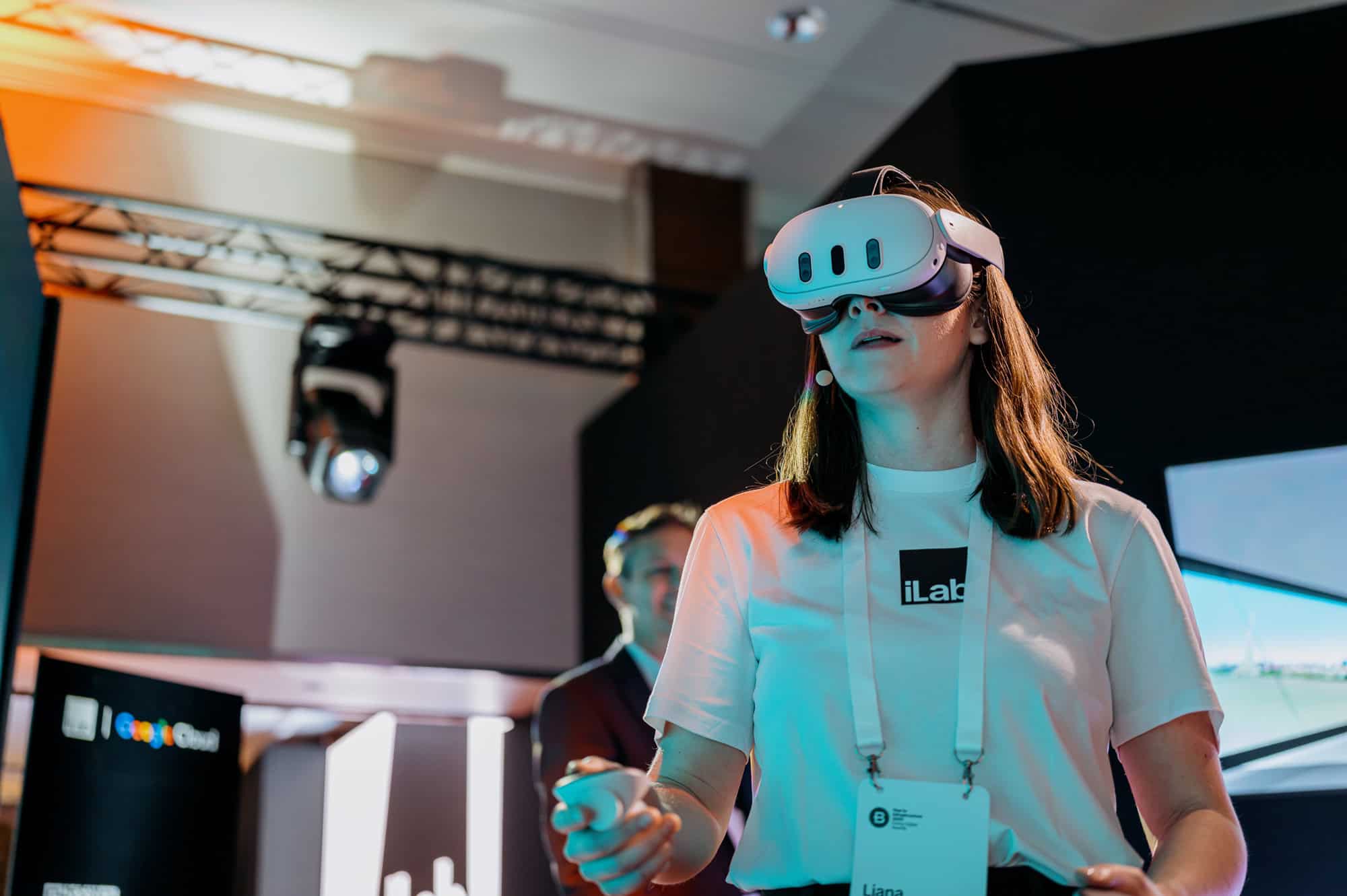
For all the complexity behind the scenes, the user experience is almost effortless. If you can look at something and tap it with your fingers, you can use it.
Reactions, O’Cleirigh says, tend to land somewhere in the neighborhood of “wow”—especially when Gaussian splats are involved. “We’re combining the most realistic reality-capture technology out there with one of the most powerful headsets ever made. We’re pushing the boundaries, and it shows.”
Both O’Cleirigh and Demchak are quick to stress that the technology is still early. Their wish list is long. They want support for additional headsets, the ability to fly users through scenes rather than drop them in, and eventually an AI guide, possibly a virtual Liana, to walk users through their experiences.
In the nearer term, Demchak says Bentley Labs plans to work with finalists for this year’s Year in Infrastructure Awards, set for October, to build immersive versions of their submissions.
For O’Cleirigh, a designer whose career began with staging optical illusions in a Dublin youth theater, it’s all of a piece. The tools have changed, but the trick—making something appear where it isn’t—hasn’t.
FAQ:
How does the Labs XR Prototype allow engineers to conduct virtual site visits?
The prototype connects to the iTwin platform and uses Cesium geospatial technology to host massive 3D design models remotely. This prevents the files from overloading the headset’s processing power. Up to five users from different locations can step inside the same model simultaneously, seeing real-time updates as changes are made.
What are the benefits of using Gaussian splats in infrastructure design?
Gaussian splats provide a highly realistic photogrammetry approach for 3D scenes. This technology captures fine details that traditional methods often miss, such as thin wires, glass reflections, and the exact way light falls on water. This allows engineers and inspectors to experience a virtual site at human scale with high accuracy.
How is XR technology being used to train infrastructure inspectors?
Instead of relying on flat computer screens, training programs drop inspectors into a one-to-one scale virtual reality experience using drone-captured data. This allows trainees to perform a realistic inspection of an asset, like a bridge, in a virtual environment to build their skills before ever stepping onto a physical job site.