

NOV 13, 2026
Bentley Survey: Data Security Top Priority For AEC Firms Adopting AI
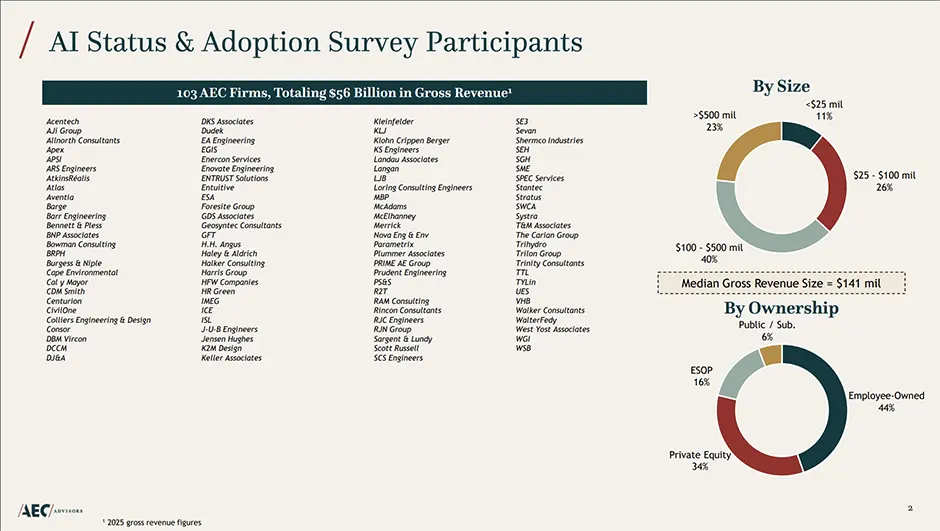
More than 100 U.S. firms in the architecture, engineering, and construction (AEC) industries provided insights about AI adoption, investment, data strategy, and where they expect AI to create value.

By Kathleen Moore
Key takeaways
- Bentley Systems and AEC Advisors LLC polled more than 100 U.S. AEC firms about AI use.
- Firms said data security was a top priority, with 45% having strict “zero-sharing” policies on external vendors using their data to train AI models.
- Larger firms were more likely to expect a "significant shift" away from traditional billing models in the next five years due to AI’s impact.
Data security is paramount as firms increasingly integrate artificial intelligence (AI) into their work, according to a new survey that found nearly half of the companies polled strictly prohibit external vendors from using their data to train AI models.
The survey—by Bentley Systems and AEC Advisors—polled more than 100 U.S. firms in the architecture, engineering, and construction (AEC) industries. Researchers asked about AI adoption, investment, data strategy, and where the firms expect AI to create value.
The findings highlight a focus on protecting proprietary data and preserving choice through open ecosystems. The survey also found that larger AEC firms are more likely to actively use AI across their business and expect a "significant shift" away from traditional billing models in the next five years due to AI’s impact.
Here are key highlights from the survey:
Data Security Is Paramount
Nearly nine in 10 firms have formal policies on external vendors using their proprietary project data to train AI models. Almost 45% have strict “zero-sharing” policies, with another third of respondents describing their policy as “exclusive use only.” (At Bentley Systems, users retain full access and control over their data that is stored and managed in Bentley products, including whether and how it's used for AI training. (Our users' data is their data, always.)
AI Adoption Broadens As Firms Scale
On AI adoption, around nine in 10 firms use the technology in business operations like human resources and finance, and 100% of the largest firms—those with more than $500 million in revenues—use it in client-facing work like proposal writing. In general, larger firms are more comfortable using AI across their operations, with more than half saying they use AI in project planning and design automation. Only three firms reported no AI in production.
Open Platforms Gain Favor
The survey asked firms which integration approach best aligned with their long-term AI strategy. The biggest share, at 37%, picked “bespoke in-house AI.” But as firms scale, they increasingly favor open ecosystems that offer greater flexibility and interoperability. Nearly a third of the largest firms picked “open ecosystem.” (Read more about why Bentley CTO Julien Moutte and other infrastructure experts advocate for connected, open systems that freely share information.)
New Business Models Lie Ahead
Most firms expect AI to affect pricing models over the next three to five years. Bigger firms are more likely to expect that impact to be substantial, with 63% of the largest firms predicting a "significant shift" away from traditional billing models in the next five years. The survey authors predicted a possible need to move away from Time and Materials or Cost Plus Fixed Fee contracts and toward a form of fixed-price or outcome-based pricing “to make AI complementary to our industry.”
AI Seen Helping Talent Shortage
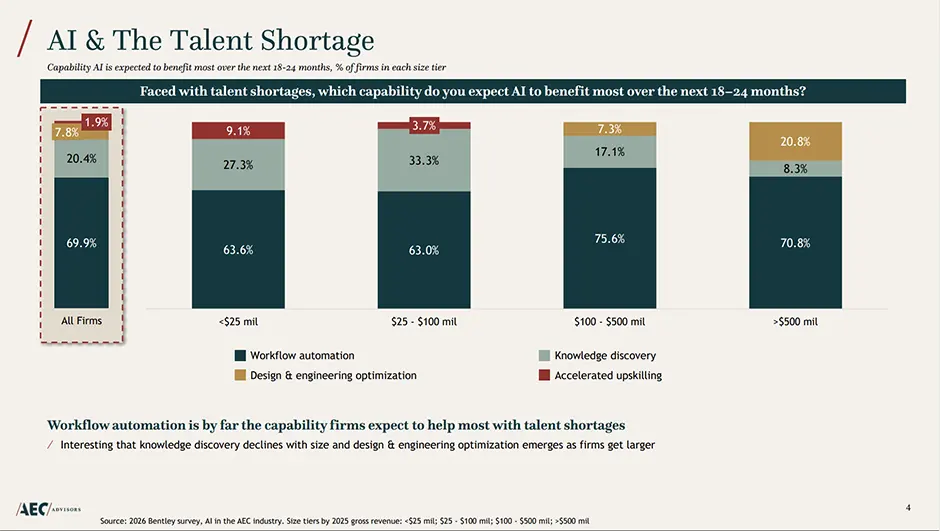
Firms expect workflow automation to be the most helpful AI capability to address talent shortages across the industry. The authors said it was interesting that “design and engineering optimization” emerged as a response to the talent shortage and grew as firms increased in size.
Big Impact, Modest Budgets
The survey also shed light on how much AEC firms are spending on AI. Overall, firms reported spending around $1 million or 0.5% of their gross revenues last year on AI. “From our perspective, these seem like very modest AI budgets,” the authors wrote.