

OCT 21, 2026
How AI Is Changing Structural Engineering Workflows

By Annik Carson, Senior Applied AI Scientist
Key Takeaways
- Structural engineering is faced with several existential pressures which AI can help address, but only if employed thoughtfully and in a way that builds trust with engineers
- Agentic workflows will change the way we do engineering work, and what workflows are available to engineers, but will build upon the skills and software that have been thoughtfully developed over years
- Tools like MCP enable engineers to access the capabilities of engineering software through natural language. MCP allows AI agents to orchestrate a wide variety of interrelated functionality to achieve critical outcomes faster. These tools are being rolled out across Bentley products now
Structural engineers design the "bones" of the built world so that buildings, bridges, and infrastructure stand safely under all the forces that occupancy, operations, and nature impose. Success is measured by efficiency and elegance of design, responsible use of materials, and the long-term resilience of structures and the communities they serve.
Disruptive technology like AI might therefore be regarded with understandable caution. Engineers must weigh the safety-criticality of their work, professional liability, and the integrity of carefully honed workflows against the pressure to rapidly adopt new ways of doing things. Yet the scale of the challenges facing the profession — a global infrastructure gap, acute talent shortages, and the urgent need to reduce the carbon footprint of the built environment — means that standing still is not a neutral choice.
In this blog post we'll talk about how AI is beginning to reshape structural engineering workflows: where it is already delivering value, where AI is creating new opportunities, and what a thoughtful path to adoption looks like in practice. As a company built by engineers for engineers, Bentley brings to this question both a deep understanding of how structural engineers work and a responsibility to ensure that the AI capabilities that we develop will earn the trust of the profession.
Pressures Facing the Engineering Sector Today

Many markets are struggling to find enough supply of skilled engineers to meet the demand of the sector today. It has been projected that only 50% of all structures that will exist by 2050 have been built today, indicating a growing demand for engineering talent. Yet, new graduates are not entering the workforce at the same rate as senior engineers are retiring , further compounding this problem – demand is growing, yet supply is shrinking. In this environment, the productivity of every working engineer matters more than it ever has.
At the same time, the work itself is becoming more demanding. Structures are more complex. Sustainability requirements are tightening. Clients expect faster delivery on fixed fees. Additionally, the effort of coordination between architects, MEP engineers, geotechnical consultants, and contractors has grown significantly as projects have become more multidisciplinary and document-heavy.
Underneath all of this sits a more fundamental problem: structural engineers spend a disproportionate share of their time on work that does not utilize their most valuable skills. Coordination emails, manual calculation documentation, drawing updates, RFI responses — this necessary work crowds out the creative and analytical problem-solving that the profession exists to do.
How Bentley is Addressing These Challenges Now
Imagine if you could sit down at your structural analysis software and simply tell it what you want in plain English, the way you'd brief a colleague. No scripting, no manual interface navigation, no switching between disconnected tools. Just describing your engineering intent, and having the software carry it out. That's not a distant prospect, it's what Bentley is building today.
Bentley's response is grounded in the idea that AI should meet engineers inside their existing tools, instead of inventing a wholly new way of working. The vehicle for this is the Model Context Protocol (MCP) — an open standard that allows AI agents to connect directly to software applications and interact with them in real time. While the LLMs that allow AI agents to converse in plain language are probabilistic, the execution of product functions is deterministic, meaning the engineering work stays firmly in the realm of understandable, traceable results.
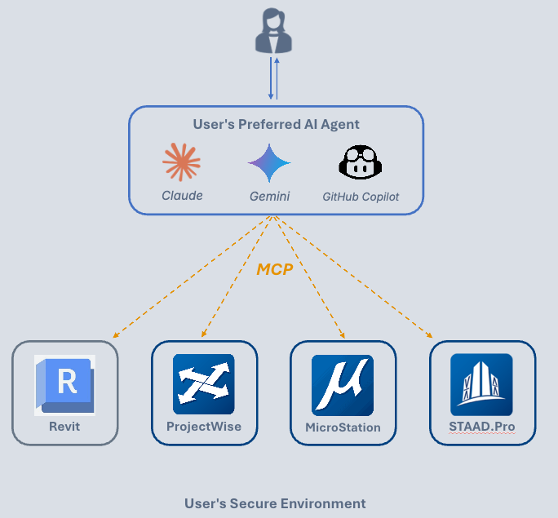
Across Bentley, our products are being modernized with MCP servers, a means by which AI agents can communicate with the product functionality – allowing users to issue instructions in natural language and have an AI assistant carry out tasks. Bentley provides an in-product AI solution, the Bentley Copilot, but the MCP servers are compatible with Claude, GitHub Copilot, Google Gemini, and other agentic AI platforms that firms might already use or evaluate. This matters because AI adoption in engineering firms is not uniform. Bentley's approach allows firms use the AI agent they prefer, whether the in-product Copilot or a third-party agent.
Bentley's MCP servers connect AI agents directly to Bentley applications. Engineers can query design data, automate complex workflows, and drive structural analysis and CAD modelling tasks using plain language, with no coding experience required. Tasks that previously required significant manual effort and detailed knowledge of the software interface become a matter of describing the engineering intent and letting the AI handle putting it all together. Engineers use their judgement to determine how to work, AI agents execute as instructed, using the functionality of the product directly. By using agents to execute deterministic product functions, mitigating the risk of AI hallucination.
MicroStation and STAAD.Pro are the first products in a planned rollout of MCP servers across the full Bentley portfolio. As more products add MCP servers, users will be able to orchestrate end-to-end workflows across multiple Bentley products — and even combine Bentley MCP servers with those of other vendors — all driven by a single AI agent. For a review of some of Bentley’s other successes using AI in these workflows, see our recent blog post here.
The long-term vision is to evolve the way we deliver our core capabilities wherever and however they create the most value for our users. We envision Bentley as an open platform for AI-enabled engineering, where our trusted capabilities can be accessed and orchestrated by the AI agents and workflows our users choose. Instead of engineering capabilities being confined within individual applications, they become building blocks for new workflows that span products, disciplines, and ultimately the infrastructure lifecycle.
How AI Tools Are Being Employed in Bentley Products
STAAD.Pro: Structural Analysis Through Conversation
The STAAD.Pro MCP server connects AI agents directly to Bentley’s flagship structural analysis software, enabling engineers to automate complex load applications, model revisions, and carry out analysis workflows using plain language, without manual interface interaction or scripting knowledge. The engineers can use AI as a tool for managing repetitive tasks, such as assigning member sizes or groupings, to move more quickly through the definition of the structure. The MCP allows an AI agent to take the engineer’s commands in natural language and convert them to STAAD.Pro commands – meaning deterministic, reproducible results – without the risk of AI hallucination. The engineer can have the AI run analyses, compare results, and use their engineering judgement to guide the path forward.
STAAD Foundation Advanced: The Foundations of AI-Enabled Structural Design
The STAAD Foundation Advanced MCP server opens the door to AI-powered foundation design. Instead of manually laying out and refining structural foundations, MCP allows the engineer to have a conversation with an AI assistant to define what they want, and have the AI handle the busy work. The AI will execute commands in STAAD Foundation Advanced to analyze the structures, soil, and loads, and will provide the engineer with recommendations for most suitable options given the constraints. The engineer makes the final decisions, but they can use the AI to access all of the functionality of STAAD Foundation Advanced that they have come to trust.
SACS: Powering Offshore Structural Analysis with AI Tools
The SACS MCP server enables AI agents to connect to SACS API which can create, modify, and review SACS data and run analyses using natural language without the need for advanced scripting knowledge. The SACS MCP skill library allows users to efficiently execute complex workflows to reduce time-consuming manual tasks, and acts as a springboard for users to create their own skills tailored to specific needs or generate SACS API scripts for efficient, reliable, and reproduceable tools that can be shared across teams and organizations that can significantly reduce your manual workload. The SACS MCP server can be used natively through Bentley Copilot or through user-provided agents for a custom set of MCP servers which can be used for complex orchestration of multiple products or APIs. With these tools, you can generate initial SACS jacket and topsides model data from pictures, drawings, or other programs, optimize your structural design, and generate and manipulate complex mesh geometries directly.
MicroStation: AI Can Work with Every Element of a Design File
The MicroStation MCP server allows AI agents to access design files, enabling infrastructure designers to automate modelling tasks and build workflows using plain language. With access to MicroStation's Python API, the AI can run any command an engineer would be able to. That means the AI can work with any element, level, reference, and view in a DGN file to carry out what the engineer wishes to accomplish. With MCP, required competency shifts from programming skill to prompting skill: engineers describe what they want in engineering terms, and the AI handles the technical execution.
iTwin IoT: Real-Time Insight from Live Sensor Data
The iTwin IoT MCP server enables AI agents to work with both live and historical sensor data, giving everyone from field technicians to C-suite executives a direct, expert-level interface to their sensor data. Teams can use plain conversation to investigate alerts, apply engineering logic, run ML analytics, and generate reports. For structural health monitoring — one of the most promising and underutilized applications of AI in the profession — this makes real-time interrogation of complex sensor networks genuinely accessible to engineers without data science backgrounds.
The Longterm Vision for AI in Engineering Software
Early adoption of AI tooling is already telling us a very important story. AI that works within commonly used workflows is more impactful and can be accessed by a wider audience than overly-specialized AI tooling requiring a high adoption overhead. Even early adopters value incremental AI solutions, where they can validate the results and progressively build trust, as opposed to a radical transformational shift. Firms making the most progress are identifying specific, bounded tasks where AI demonstrably reduces burden, measuring the results, and expanding from there.
That makes our goal clear: not to flash AI for the sake of AI, but to earn the confidence of engineers through results and transparency. That means tools that explain their reasoning, make outputs easy to verify, and fail visibly rather than silently. Our next generation of AI solutions will build on top of what MCP server functionality has enabled, all while keeping this need for transparency and traceability top of mind.
Automating the Repetitive
The most immediate application of AI is the automation of routine, rule-based tasks: generating reports, checking drawings for common errors, flagging missing information in BIM models. Engineering software is rapidly responding to this opportunity by enabling AI tools that can handle much of this work, freeing engineers to focus on tasks where their expertise is genuinely needed.
Structural Health Monitoring
For existing infrastructure, AI is enabling a shift from periodic, backward-looking inspection to continuous, predictive monitoring: detecting anomalies in real time and prioritizing maintenance before problems become critical. This matters enormously in a world where existing infrastructure is aging and preventative maintenance is often more environmentally conscious and cost effective.
Design Exploration and Optimization
Machine learning approaches trained on libraries of prior analyses can predict structural behavior at a fraction of the time. This is particularly valuable in early design stages, where rapid feedback can shape decisions before significant effort has been committed. This also opens the door to rapid design-space exploration using these light-weight alternatives to full simulation: estimate structural behavior on thousands of possible configurations, optimizing for specific criteria, then choose a few of the best solutions on which to run a full structural analysis. Additionally, AI-powered generative design tools can evaluate thousands of configurations in the time it would take an engineer to assess a handful, surfacing solutions that balance competing objectives in ways that conventional iteration would not reach. Engineers can explore a wide solution-space for design alternatives and have more information for making decisions when weighing competing objectives.
Generative Design
A firm's archive of past projects is one of its most undervalued assets. Generative design workflows use AI to turn that historical data into an active resource: one that can propose design options, flag proven approaches, and help engineers move faster from brief to viable solution. This empowers users to leverage AI to unlock value from past project data, uncovering patterns, reusing proven solutions, and generate new design options grounded in what has worked before.
What This Means for the Profession
The demand for structural engineering expertise is growing. AI presents new opportunities for engineers to rise to meet these demands, and unlocks new value for both engineers and their clients. The composition of the work will likely change: routine tasks will increasingly be handled by AI contributors, while engineers will see a rising premium on judgment, creativity, and the ability to work with these tools effectively.
The structural engineers best positioned for this future are those who combine rigorous technical foundations with fluency in the capabilities and limitations of AI — who can direct these tools with sophistication, interpret their outputs with a critical eye, and take responsibility for decisions that no algorithm can make on their behalf. That combination of deep expertise and thoughtful use of powerful tools has always been what the best engineering looks like.
Bentley Systems has been building engineering software for over four decades, in close partnership with the engineers who use it. Our approach to AI reflects that history: careful, grounded in real workflows, and accountable to the professionals whose work keeps the world standing.
References