
OCT 08, 2026
12 Projects From 11 Countries Win Bentley's 'Oscars of Infrastructure' in Singapore as AI Takes Center Stage
Independent jurors chose the winners from more than 300 nominations, with nearly 70% of finalists using AI in their work. "What is today's innovation is tomorrow's best practice," said Bentley CEO Nicholas Cumins.
By Tomas Kellner
Key takeaways:
- Twelve winners chosen from more than 300 projects in 53 countries.
- Nearly 70% of finalists used AI in their work.
- Independent jurors judged on innovation, community impact, and sustainability.
Independent jurors picked the winners of Bentley Systems' 2026 Year in Infrastructure Awards in Singapore on Wednesday night, capping two days of presentations by teams building some of the world's most ambitious bridges, tunnels, ports, power stations, and water systems.
The 12 winners—from Portugal, India, Ireland, China, the Philippines, Poland, the Czech Republic, Australia, Indonesia, Brazil, and the Netherlands—were selected from more than 300 nominations submitted by engineering firms, government agencies, and other organizations in 53 countries. Bentley also presented Founders' Honors to 16 projects, including a road tunnel on Singapore's own North-South Corridor.
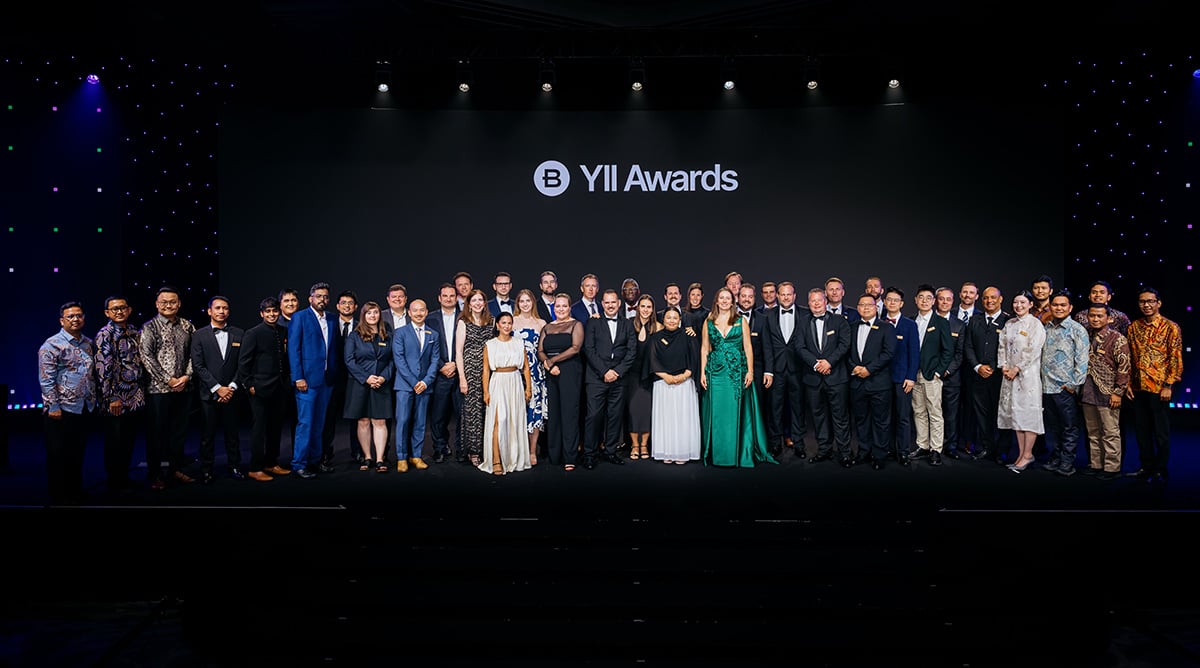
Judging is a months-long process, said Sachi Munshi, the Bentley corporate marketing manager who helped organize the awards program. A panel of some three dozen independent jurors—industry experts, analysts, journalists, and past finalists—reviews every submission and scores it against metrics set for each of the 12 categories before narrowing the field to three finalists each. In Singapore, the finalists presented their work in person, and the jurors deliberated until they reached consensus.
"It's very difficult to find the negatives, to be very honest," said Ananya Narain of Geospatial World, a juror in the Geospatial and Reality Modeling category. Jonathan Bradley of create magazine, which is published by Engineers Australia, judged Project Delivery. He said the hardest part was comparing projects of so many different types and stages. Still, he said, "I don't think I've ever been on a panel where we've wrapped up and someone's left the room thinking that the wrong project was chosen."
Both jurors pointed to the same shift this year: AI. "One of the questions that all the jurors this time focused on was how much of the workflow was automated," Narain said. "We did not see that last year."
In his keynote, Cumins put a number on that observation: nearly 70% of finalists and more than a quarter of all submissions used AI in their work. He described a clear division of labor between engineers and machines. "Optimization belongs to the machine," he said. "But navigating the trade-offs belongs to the engineer."
Cumins said what sets infrastructure engineers apart is that they share what they learn. "What is today's innovation is tomorrow's best practice," he said.
The full list of winners and Founders' Honors recipients is on Bentley's YII Awards website.